
Differences on Garabagh settlement persist
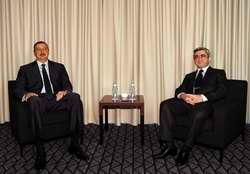
International mediators brokering a settlement to
the Upper (Nagorno) Garabagh conflict expressed hope after last
week`s meeting of Azerbaijani and Armenian Presidents Ilham Aliyev
and Serzh Sarkisian in Zurich, Switzerland. At the meeting it was
decided that the two countries would strike a common ground on
resolving the long-standing dispute.
"The co-chairs hope the parties will be able to bridge these remaining differences in the near future to secure a peace agreement that is far better for all parties than the status quo. Their goal is a just and balanced agreement based upon the Helsinki Final Act principles of territorial integrity, self-determination, and non-use of force," the co-chairmen of the OSCE Minsk Group said in a statement.
The co-chairs - Bernard Fassier of France, Yuri Merzlyakov of Russia and Matthew Bryza of the United States - traveled to Baku on January 19, where they met with President Aliyev and Foreign Minister Elmar Mammadyarov, and to Yerevan on January 20, where they met with President Sarkisian and Foreign Minister Eduard Nalbandian.
The mediators again met as a group with the foreign ministers in Zurich on January 27 and organized a joint meeting with Presidents Aliyev and Sarkisian in Zurich on January 28, on the sidelines of the World Economic Forum.
The co-chairs explored with the two presidents their thoughts on how to finalize the basic principles on the peaceful settlement of the Garabagh conflict, proceeding from the proposal presented to the sides at the OSCE Ministerial Conference in Madrid in November 2007.
The co-chairs agreed to work with the foreign ministers on elaborating proposals "for the consideration of the two presidents on the most important remaining differences between the sides existing within the framework of the basic principles."
US mediator Matthew Bryza said the presidents` meeting proceeded positively and constructively, and progress was achieved in narrowing the differences between the conflicting sides on the basic principles of the peace process. He noted that the co-chairs would visit the region in February "to further move forward the positive environment achieved."
Overall, the co-chairs described both the presidential and ministerial talks as a step toward settling the Garabagh conflict.
The two ministers also expressed their satisfaction with the outcome of presidential talks.
The Azerbaijani Foreign Minister said the parties discussed both the principles of the peace process that are currently being planned and the existing peace.
"There are some issues pertaining to the basic principles that remain to be agreed upon. Each president stated his views on these issues in terms of mutual understanding. Naturally, this is a complicated process, but it is necessary to take steps moving forward. There is no other way," Mammadyarov said.
Armenian Foreign Minister Nalbandian said the talks had been held in line with the basic documents outlining the peace process.
"Both presidents stressed a certain dynamics in the Garabagh conflict settlement from the viewpoint of holding talks on a regular basis. With each meeting, the sides are understanding each other better and trying to resolve outstanding challenges and hurdles.
"I would also like to note that we are now talking about drafting the principles of the conflict settlement. After the basic principles are agreed upon, the parties will tackle work on basic documents," Nalbandian added.
The Zurich talks were the third meeting between the Azerbaijani and Armenian leaders. The two earlier met in St. Petersburg and Moscow. Their previous meeting in the Russian capital, which took place at the request of Russian President Dmitry Medvedev on November 2, 2008, concluded with the signing of a declaration, the first document inked by the two heads of state in the past 16 years.
Armenia and Azerbaijan waged a war over the mountainous region of Upper Garabagh in the early 1990s, which claimed some 30,000 lives and displaced about one million Azerbaijanis. Armenia has been occupying over 20% of Azerbaijan`s internationally-recognized territory since then. The ceasefire accord was signed in 1994, but peace talks have accomplished little so far. Sporadic clashes on the frontline continue.
Here we are to serve you with news right now. It does not cost much, but worth your attention.
Choose to support open, independent, quality journalism and subscribe on a monthly basis.
By subscribing to our online newspaper, you can have full digital access to all news, analysis, and much more.
Subscribe
You can also follow AzerNEWS on Twitter @AzerNewsAz or Facebook @AzerNewsNewspaper
Thank you!