
The place where time has frozen
By Seymur Aliyev
Residents of the unique Khinalig village in Azerbaijan believe that they are successors of Prophet Noah. They assert that during Noah's storm the Ketish village was located in the Ketish Mountains. But due to the earthquake which Allah had sent upon them, everything was destroyed and villagers had to move up to the top of another mountain and to found a new village, which is currently known as Khinalig.
This is a little part of Azerbaijan which has remained unchanged for over 5,000 years. It is a place reflecting ancient history and proving the antiquity of Azerbaijani culture.
The people of Khinalig say that after the devastating Noah's storm, two sons of Noah, Shem and Ham, migrated to different places and only one son, Japheth, stayed there and became progenitor of Caucasians. Shells and fossils of the fish found in the village, which is located over 2,000 meters above sea level, is proof of this historic truth.
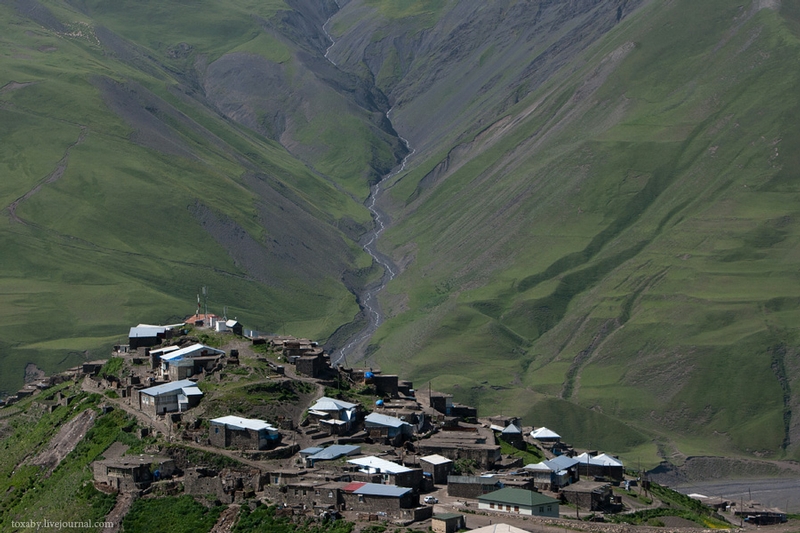
Khinalig is an ancient Caucasian village dating back to the period of Caucasus Albania. It is located high up in the mountains of the northeastern Guba region in Azerbaijan. It is also a municipality in the Guba region, which consists of the villages of Khinalig and Galaykhudat.
It is located just north of Guba in the middle of the Greater Caucasus mountain range that divides Russia and the South Caucasus. Khinalig is also the highest, most remote and isolated village in Azerbaijan and is among the highest in the Caucasus. The weather there changes dramatically during summer and winter, ranging from −20 °C to 18 °C. Khinalig has a population of about 2,000 people. This small group of people speaks the Khinalig language, which belongs to the Northeast Caucasian language family, although many speak Azerbaijani as well.
The "Khinalig" ethnic group has been living in the Caucasus for thousands of years; these people have not lost their language, customs and traditions and have preserved them to this day. According to historical researches and legends, the age of the village is assumed to be around 5,000 years.
The meaning of the word "Khinalig" is not linked to its history. The village derives its name from the color which the Sun emits when it rises (khina - henna). Since the ancient times, the population of Khinalig calls their village "Ketish", which means "sacred".
Ancient Greek scholar Strabo wrote in his 17-volume work named "Geography" that 26 Albanian tribes used to live in the Caucasus Albania and each of those tribes spoke its own language. The Khinalug tribe is one of those Albanian tribes and since that time they have spoken their source language.
It is worthy of note that the majority of the graves in the Khinalig cemeteries are quite large both in width and length. Visual proof to that is the open graves, which are located along the road going to Rutsosh River. Some of the graves in Khinalig have three floors.
Islam began to spread in Khinalig in the 12th century by Abu Muslim. The mosque that functions there nowadays had been built during that time and the people named this mosque the Abu Muslim Mosque. Before adopting the Muslim religion, the Khinalig people used to be fire worshippers.
4-5 km west of Khinalig, there is a place called "Ateshgah", from where natural gas is discharged.
Today, the Khinalig village attracts many tourists, who crave for mountain climbing and studying ancient history.
Here we are to serve you with news right now. It does not cost much, but worth your attention.
Choose to support open, independent, quality journalism and subscribe on a monthly basis.
By subscribing to our online newspaper, you can have full digital access to all news, analysis, and much more.
You can also follow AzerNEWS on Twitter @AzerNewsAz or Facebook @AzerNewsNewspaper
Thank you!