
Baku, Tehran ink MoU on comprehensive cooperation
By Sara Rajabova
Iran and Azerbaijan are taking real steps to expand the bilateral economic and trade relations.
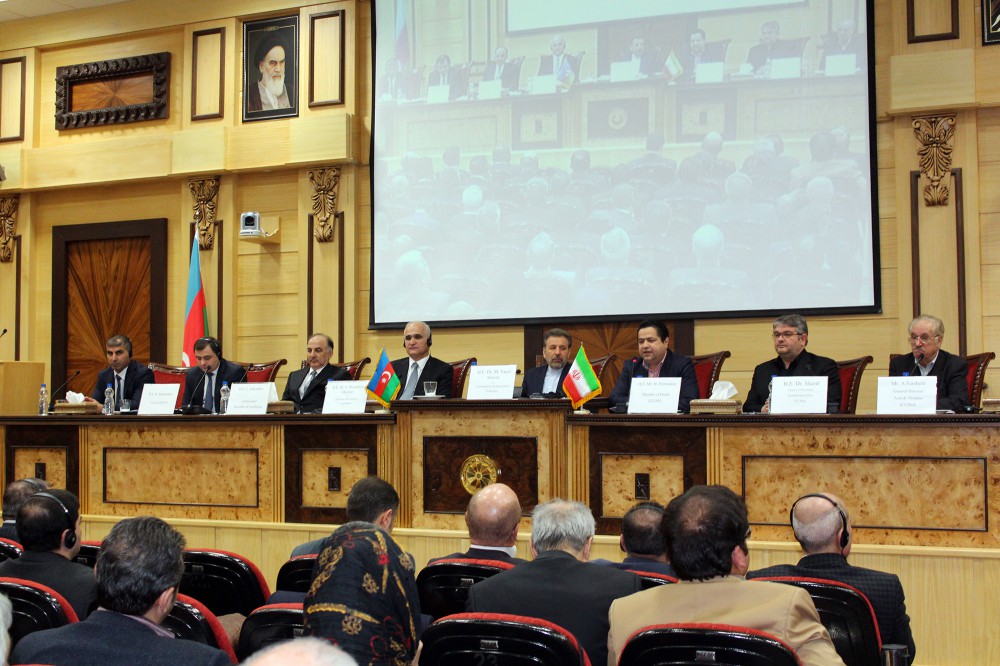
The two neighboring countries have insured their steps by signing an agreement on developing of the cooperation in the fields of industry, agriculture, construction, food industry, finance, consulting, tourism and etc. at a Tehran meeting of the 10th Joint Economic Cooperation Commission on December 22.
The final memorandum of understanding, inked by Mahmoud Vaezi, Iran’s Minister of Communications and Information Technology and Shahin Mustafayev, Azerbaijan’s Minister of Economic Development, covers cooperation issues in 12 various sectors, according to Iranian media.
This comes as the two economies have significantly expanded cooperation in recent years. The agreements covering different fields were cemented with the deals in 2015. The recent MoU is believed to further foster the economic cooperation between the two neighboring states.
The document envisages investment making in oil projects, as well as settling gas swap disputes and coordination for using Azerbaijan’s gas storage facilities.
Vaezi earlier said Tehran intends to increase its stake in the Azerbaijani Shah Deniz gas project, noting that negotiations on this issue are already underway with the Azerbaijani side.
Another project of cooperation between Baku and Tehran is the power plant construction. Based on the signed document the two parties will cooperate in construction of power plants at Khoda Afarin and Qiz Qalasi dams on Araz river and following the issue of agreement on the construction of "Ordubad" power plant on the Azerbaijani side and "Marazad" power plant on the Iranian side as well as implementation of joint guideline on border rivers’ water management.
Iran and Azerbaijan also interested in electricity swap. Azerbaijan will start exporting electricity to Iran from 2016, according to Mustafayev.
The document signed in this field envisages the definitive tariff for electricity purchase and sale between the two countries. As they seek the exchange of electricity, the two countries expect it will become operational during the first three months of 2016.
Vaezi said by implementation of the document, the ground will be prepared for Azerbaijan, Iran, Georgia and Russia to make a link between their electricity networks.
The sides also discussed ways to increase the trade turnover and investment projects.
Currently, more than 450 companies with Iranian capital operate in Azerbaijan, and the volume of Iranian investments in the country is around $760 million, according to the Azerbaijani officials.
Azerbaijan and Iran seek to set up joint ventures in the production and processing of agricultural products. The enterprises will be created on both the Azerbaijani and Iranian territory under the agreement reached between the sides.
Azerbaijan’s Industry and Economic Development Ministry told Trend that it is assumed that agricultural products at these enterprises will be sent to Russia by transit through the territory of Azerbaijan, as well as in the western direction, to the Black Sea, through the territory of Azerbaijan and Georgia.
The two countries also reached an agreement on attracting Iranian investors to participate in Azerbaijan’s Sumgait Chemical Industrial Park. They plan to take appropriate measures to encourage the participation of Iranian investors in the chemical industrial park.
Moreover, as part of the Azerbaijani-Iranian meeting, Azerbaijani Akkord Industry Construction Investment Corporation signed a memorandum of understanding with Iran’s Abad Rahan Pars International company.
The two countries also call for connecting their railways. In this regard, they aim to finalize the first phase of the project to create the North-South railway corridor before late 2016.
The North-South railway project is expected to bring great profits to Azerbaijan and Iran. The railway’s capacity will stand at 1.4 million passengers and 5-7 million metric tons of cargo per year, according to the preliminary estimations.
The construction of Astara-Astara and Rasht-Astara part within the project falls within Iran and Azerbaijan’s responsibility and the two countries are making effort to build the sections.
Azerbaijan and Iran have also agreed to switch the customs checkpoints in Azerbaijan’s Astara and Bilasuvar regions to the around-the-clock operation. Currently, the border checkpoint in Julfa operates around the clock.
The trade turnover between Azerbaijan and Iran amounted to $110.6 million in January-November 2015. Some $80.5 million of this amount accounted for imports from Iran, according to the Azerbaijani State Customs Committee.
Iranians have recently shown great interest in developing trade relations with neighboring. Trade turnover between Iran and Azerbaijan surpassed $405.63 million during the first ten months of past Iranian fiscal year (March 21, 2014-January 21). However, Iran and Azerbaijan have set a goal to increase this figure by four times, up to $2 billion.
Azerbaijan and Iran have shared diplomatic relations since 1918. Iran recognized Azerbaijan's independence in 1991, and diplomatic ties between the two countries were reestablished in 1992.
--
Sara Rajabova is AzerNews’ staff journalist, follow her on
Twitter: @SaraRajabova
Follow us on Twitter @AzerNewsAz
Here we are to serve you with news right now. It does not cost much, but worth your attention.
Choose to support open, independent, quality journalism and subscribe on a monthly basis.
By subscribing to our online newspaper, you can have full digital access to all news, analysis, and much more.
You can also follow AzerNEWS on Twitter @AzerNewsAz or Facebook @AzerNewsNewspaper
Thank you!