
CIS bankers ring alarm over impact of global financial crisis
Countries making up the Commonwealth of Independent States may
see a severe impact from the global financial crisis unless action
is taken soon to alleviate its impact, CIS bankers have warned.
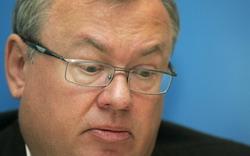
Andrey Kostin, chairman of the CIS Financial and Banking Council
(FBC) and of Russia’s major bank VTB, said a reduction in Gross
Domestic Product is already predicted in Russia, while banks in
Kazakhstan have faced financial losses.
"To prevent other CIS states from becoming infected by this
crisis-like epidemic, a CIS analysis center should be set up and
collective financing carried out. CIS countries are not insured
against crises and losses," Kostin told a conference in Baku last
week.
The goal of the two-day conference was to discuss the impact of the
financial crisis in world markets on CIS banks and to seek
solutions to stabilize local banks. The conference was attended by
representatives of 10 banks from eight countries of the former
Soviet bloc.
Kostin said one of the key conditions for warding off the crisis
was developing new prospective projects which required drafting
proposals in cooperation, not by separate CIS states.
He said another priority was providing assistance to those CIS
banks that have been most seriously affected by the crisis.
Further, the Council chairman emphasized that CIS states should be
cautious regarding the falling rate and influence of the US dollar,
which plays a key role in the world's financial system, and work to
strengthen their national currencies.
"The global financial crisis has shown that there is a flaw in the
world banking system. The reported loss is estimated not in
millions, but billions of dollars. Analysts predict that economic
growth will slow down in the West and there will be significant
staff-cuts in bankrupt companies, while the slowing economy will
affect other fields," the banker said.
Anatoli Kazakov, chairman of the FBC's Coordinating Council, said
the damage inflicted to CIS banks by the global financial crisis
amounted to $1.3 billion. He said close cooperation among CIS
states was pivotal to preventing the losses from increasing.
"Among CIS states, Azerbaijan is the country moving the most
cautiously and taking the most pre-emptive and preventive measures
against the global financial crisis," he said, explaining this
conclusion based upon the recent reduction of interest rates by the
central bank, regulation of credits, preference to keeping hedge
funds in the national currency, manat, and other measures.
"As is seen, the global crisis has had only a minute impact on
Azerbaijan's economy and banking system," Kazakov said.
Sergei Lebedev, chairman of the CIS Executive Committee, said in
his remarks that an Innovation Fund among the union's member states
should be established to prevent the impact of the worldwide crisis
from harming CIS banks. He said the current situation showed that
the fund was needed to provide assistance and keep the investment
climate under control.
"Certainly, it is impossible to develop the banking sector without
investment. I believe that to ensure efficient implementation of
investment projects, first of all, a relevant financial system
should be in place. The Innovation Fund could ensure efficiency of
projects by overseeing the financial system."
Lebedev added that among steps to fence off the global financial
crisis was forging close cooperation among CIS banks, finance
ministries and governments, as well as undertaking joint
activities.
'No threat to Azerbaijan'
The global financial crisis will have no substantial impact on
Azerbaijan, the central banker has said.
"Azerbaijan's banking system is insured against the crisis," said
Elman Rustamov, board chairman of the National Bank of Azerbaijan
(NBA). "Azerbaijan, which maintains high economic indicators, has
sufficient currency reserves. There is no threat of risk given that
the country's financial reserves are twice over its foreign
debt."
Rustamov said the Azerbaijani government had chosen the most
conservative model in protecting the country's financial reserves.
These funds, he said, are being placed in the central banks of the
world's leading countries and international financial institutions.
The high status of these banks rules out any threat posed to
Azerbaijan's reserves.
"Naturally, this model will ultimately cause the profit yield to go
down somewhat, but the key goal now is not to secure high
profitability of reserves, but to protect and preserve them," the
central banker said.
Macro-economic stability reigns in Azerbaijan, and local banks have
only been slightly affected by the global crisis. Foreign debt of
those banks operating in the country equals only $2 billion.
Rustamov added that if the financial crisis persists, pre-emptive
steps being taken would reduce its impact on the country.
Here we are to serve you with news right now. It does not cost much, but worth your attention.
Choose to support open, independent, quality journalism and subscribe on a monthly basis.
By subscribing to our online newspaper, you can have full digital access to all news, analysis, and much more.
You can also follow AzerNEWS on Twitter @AzerNewsAz or Facebook @AzerNewsNewspaper
Thank you!