
Ruble sinks as Nordea sees deeper slump on Kazakh contagion, oil
By Bloomberg
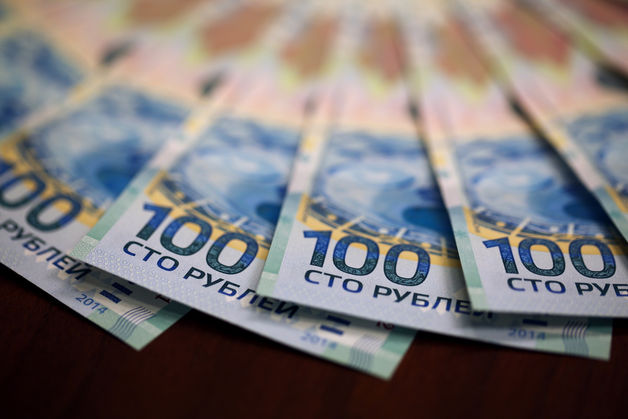
Russia’s ruble sank to the lowest level in more than six months, prompting Nordea Bank JSC to predict further losses after neighboring Kazakhstan devalued its currency and oil extended its decline.
The ruble dropped for a sixth day, retreating 1.4 percent to 67.53 against the dollar at 1:45 p.m. in Moscow, the weakest since Feb. 4. Local currency government bonds fell for a fourth day, lifting the five-year yield 24 basis points to 11.53 percent, the highest since April 28. Stocks gained.
A glut in oil and China’s slowing economy are pounding the ruble and Russian bonds along with most emerging-market assets. Kazakhstan, one of Russia’s 10 biggest export markets and an oil producer, announced the switch to a free-floating currency on Thursday, mirroring a move by Moscow in November.
“Although these events aren’t a direct menace to the ruble, the multiplication effect and the general negative background increase the pressure on the ruble,” Denis Davydov, an economist at Nordea in Moscow, said by e-mail. “The next target for the short term is 70 rubles per dollar.”
The median forecast of analysts surveyed by Bloomberg is 62 rubles per dollar at the end of the third quarter.
The Micex Index of stocks gained 0.8 percent to 1,687.81. The exporter-heavy group typically earns revenue in foreign currenies.
The dollar-denominated Market Vectors Russia ETF dropped 2.8 percent to $15.69 in New York on Wednesday. The fund tumbled for the seventh day, the longest losing streak since December, when policy makers pushed the key interest rate up 6.5 percentage points to stem the ruble rout.
Export Revenue
Brent crude, the benchmark for half of the world’s oil, retreated 1.7 percent to $46.37 per barrel, a six-year low. Oil in rubles rose to 3,131 rubles per barrel, 10 percent below the 12-month average, signaling the Russian currency remains strong relative to the crude price.
The strength threatens to diminish Russia’s earnings from oil exports at a time when the economy is shrinking, with analysts forecasting the biggest budget shortfall since 2010.
Plunging oil prices and the rout in emerging markets may prompt the Federal Reserve to delay a much-broadcast rate increase in September, helping to keep ruble weakness in check, Yury Tulinov, head of research at Rosbank PJSC in Moscow, said in e-mailed comments.
“I don’t believe oil will stay below 50 for a long time,” he said. “And it makes it hard for the Fed to raise interest rates in September.”
Here we are to serve you with news right now. It does not cost much, but worth your attention.
Choose to support open, independent, quality journalism and subscribe on a monthly basis.
By subscribing to our online newspaper, you can have full digital access to all news, analysis, and much more.
You can also follow AzerNEWS on Twitter @AzerNewsAz or Facebook @AzerNewsNewspaper
Thank you!