
Turkey stocks drop with bonds as lira weakens past 3 per dollar
By Bloomberg
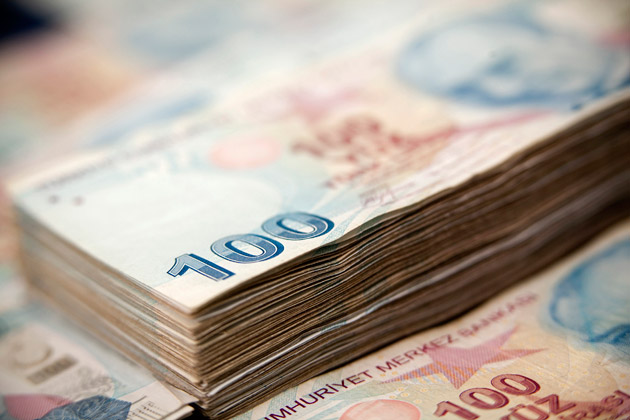
Turkey’s lira weakened past 3 per dollar for the first time, sending stocks and bonds falling, as the country’s economic and political woes mounted amid a selloff in emerging markets.
The currency depreciated as much as 2.7 percent to trade at 3.0031 per dollar in Istanbul. It was at 2.9667 as of 10:19 a.m. local time, bringing its retreat this year to 21 percent. The Borsa Istanbul 100 Index of stocks dropped 1.5 percent to the lowest since Oct. 16. The yield on two-year government bonds jumped 20 basis points to 10.91 percent, the highest level since March 2014 on a closing basis.
“The fundamentals affecting the lira haven’t changed and we could have expected the Fed minutes to ease the pressure on it at least temporarily,” Pinar Uslu, a strategist at ING Bank in Istanbul, said by e-mail. “The sharp move this morning suggests lira selling could be related to triggering digital options at the 3.00 mark in an illiquid market. There is no way to confirm the above, we may be in for a choppy few hours.”
The lira is this year’s third-worst emerging-market currency following inconclusive general elections in June and as Kurdish, Islamic and leftist militants have stepped up attacks in Istanbul and elsewhere over the past months. The central bank left Turkey’s interest rates unchanged on Tuesday, and signaled at a meeting with economists yesterday it may not raise borrowing costs before the Federal Reserve.
Currencies across emerging markets have depreciated this month. The tenge plunged to a record after Kazakhstan relinquished control of its exchange rate, becoming the latest country to abandon efforts to prop up its currency before the U.S. raises interest rates. Vietnam devalued its currency on Wednesday for the third time this year after a similar move in China last week triggered the yuan’s steepest slide in two decades.
‘Behind the Curve’
Turkey is more reliant on capital inflows than many countries because of the size of its current-account deficit, making it among the most vulnerable economies to higher U.S. borrowing costs. Fed officials yesterday indicated concern about stubbornly low inflation, even as they signaled that an improving job market is bringing them closer to the first interest-rate increase in almost a decade.
While Turkish policy makers kept borrowing costs on hold for a sixth month this week, they’ve pushed the weighted-average cost of central bank funding up more than 100 basis points to 8.67 percent as of yesterday. The bank decided to implement a tighter liquidity policy “as long as deemed necessary,” it said in a statement accompanying its rates decision.
“It’s hard to find a catalyzer that can reverse lira’s decline,” said Akin Tas, vice president of derivatives trading at Istanbul-based Akbank TAS. “The market fears the central bank will remain behind the curve. Investors may have taken the Fed’s dovish statement as a sign that the Turkish central bank could be unwilling to raise rates until the first Fed rate hike to curb lira weakening.”
Violence
The nation’s economy will probably grow 3 percent in 2015, less than the 5.4 percent average in the past five years, according to data compiled by Bloomberg. While inflation has decelerated for two months to 6.8 percent in July, consumer- price increases remain above the central bank’s 5 percent target.
Societe Generale SA analysts Phoenix Kalen and Roxana Hulea said the lira may depreciate to as low as 3.2088 per dollar in an e-mailed note on Wednesday.
A flare up in violence added to pressure on the lira on Wednesday, as assailants tossed a grenade at a guard post at Istanbul’s Dolmabahce Palace and then opened fire, setting off a gun battle in the center of Turkey’s largest city. No one was killed and two members of a leftist extremist group were detained.
Eight soldiers were killed when the Kurdistan Workers’ Party, or PKK, detonated a land mine under an armored vehicle yesterday in the southeastern town of Siirt, state-run TRT TV reported.
A Turkish multi-front offensive against terrorist groups and the collapse of a three-year truce with Kurdish militants followed parliamentary elections in June that failed to deliver a ruling majority to any one party. Talks to form a coalition government failed and Turkey may be headed for fresh elections within about three months.
Nationalist opposition leader Devlet Bahceli called on Wednesday for the use of martial law in war-torn areas.
Here we are to serve you with news right now. It does not cost much, but worth your attention.
Choose to support open, independent, quality journalism and subscribe on a monthly basis.
By subscribing to our online newspaper, you can have full digital access to all news, analysis, and much more.
You can also follow AzerNEWS on Twitter @AzerNewsAz or Facebook @AzerNewsNewspaper
Thank you!