
Ruble seen extending worst drop since January on debt, Greece
By Bloomberg
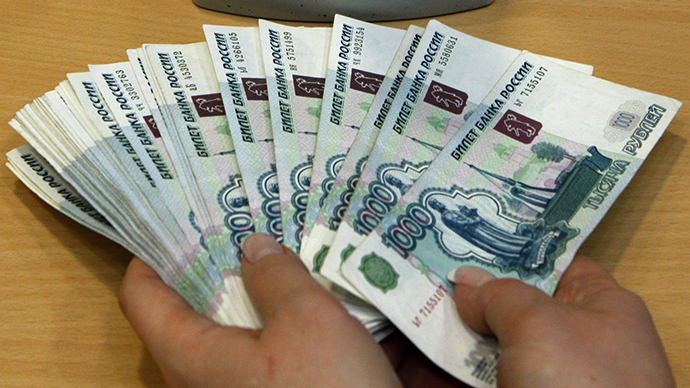
The ruble trimmed its biggest monthly drop since January, with PAO Rosbank, Credit Suisse Group AG and Renaissance Capital seeing more weakness in the third quarter because of the crisis in Greece and external debt payments.
Russia’s currency added 0.2 percent to 55.585 against the dollar at 1:40 p.m. in Moscow as Brent crude climbed the most in a week. The ruble is headed for a 5.9 percent drop this month, the most since January, while Brent crude is 4.3 percent weaker in June. Bonds gained before the announcement of Wednesday auction terms and the third-quarter borrowing plan.
The rising likelihood Greece will leave the euro region is one more reason to be wary of the Russian currency. Oil-price risks and looming foreign-debt payments, in addition to the central bank’s foreign-currency purchases, will continue exerting pressure on the ruble in the next three months, according to RenCap and Rosbank.
“We’re expecting further weakness for the ruble in the upcoming quarter, with the nearest target at 60 against the dollar,” Yury Tulinov, the head of research at Rosbank in Moscow, said by e-mail. “Overall the combination of Greece, oil, the central bank interventions and debt redemption is negative for the ruble.”
Greece triggered a $1.5 trillion global equity rout Monday after it called for a July 5 referendum on creditor demands, closed its banks and imposed capital controls. It’s set to withhold a $1.7 billion payment to the International Monetary Fund. Starting at midnight, it will also no longer be formally under the protection of a euro-area bailout program.
Cash Pile
The ruble is the biggest decliner among emerging-market currencies this month. The Bank of Russia bought about $5.96 billion since May 13 as it seeks to boost the nation’s reserves to $500 billion from $361 billion.
Brent crude climbed 1.1 percent to $62.69 a barrel on Tuesday. It touched a six-year low of $45.19 on Jan. 13 and reached $69.63 on May 6.
RenCap forecasts the ruble will average 57 against the dollar during the rest of the year if Brent is at $60 a barrel and if the central bank resumes spending reserves in the fall, according to Oleg Kouzmin, RenCap’s economist in Moscow.
“Ruble pressures could start building up closer to September,” Kouzmin said by e-mail. “Foreign investors could start converting dividend receipts from our biggest oil and gas companies into dollars at the end of summer, while companies and banks face another increase in external-debt redemptions at the start of autumn.”
Debt Payments
Russian companies face about $33 billion in foreign-debt payments in the three months through Sept. 30, compared with about $21 billion in the second quarter, according to central bank data. Yields on the government’s five-year notes fell two basis points to 11.25 percent.
The Micex Index of stocks added 0.3 percent to 1,639.71, led by OAO Lukoil and OAO Sberbank. The dollar-denominated RTS Index climbed after dropping to the lowest since June 8 on Monday.
“We expect further gradual weakening of the ruble,” Alexey Pogorelov, the chief economist for Russia at Credit Suisse Group AG, said by e-mail. “The central bank policy of beginning interventions was a game-changer.”
Russian officials warned in April the ruble’s world-beating advance this year had gone too far as a stronger currency crimps Russia’s export revenue.
Here we are to serve you with news right now. It does not cost much, but worth your attention.
Choose to support open, independent, quality journalism and subscribe on a monthly basis.
By subscribing to our online newspaper, you can have full digital access to all news, analysis, and much more.
You can also follow AzerNEWS on Twitter @AzerNewsAz or Facebook @AzerNewsNewspaper
Thank you!