
Bank of Israel leaves Benchmark rate at record low 0.1 percent
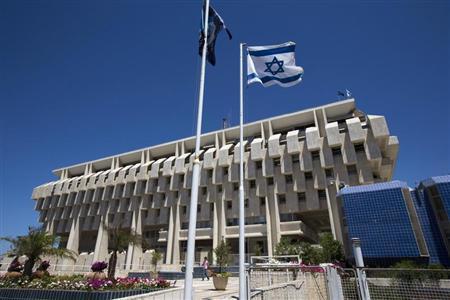
By Bloomberg
The Bank of Israel left its interest rate unchanged at a record low, amid expectations negative inflation will reverse course.
The five-member monetary panel, led by Governor Karnit Flug, kept the benchmark rate at 0.1 percent on Monday. Seventeen of 22 economists surveyed by Bloomberg had forecast the decision, while the remainder predicted a cut.
Israel’s consumer price index is projected to rise 1.1 percent over the next 12 months, according to a survey of economists, the central bank said May 18, bringing inflation within the target range of 1 percent to 3 percent. While the index fell 0.5 percent in April from a year earlier, its eighth consecutive monthly decline, the drop was less than in the previous two months.
The “slightly firmer headline CPI print in April” offered “an excuse for the central bank to postpone further easing, for now,” Goldman Sachs analyst Kasper Lund-Jensen said by e-mail before the rate decision.
Lund-Jensen and several other analysts say Flug will eventually cut rates to zero to spur inflation and weaken a strong shekel that is hurting exports. The central bank will be “likely to use its last couple of rate cuts carefully such that it will not be cornered and forced to use” unconventional policy tools such as currency interventions or quantitative easing, Lund-Jensen said.
The shekel weakened by more than 2 percent against the dollar in the past 10 days. It was trading at 3.8955 at 1:55 p.m. in Tel Aviv.
Increases Seen
There is no justification for further rate reductions with consumer prices expected “to return to positive territory in coming months, spurred by rising real estate prices,” Ori Greenfeld, chief economist at Psagot Investment House, said last week. If the shekel appreciates 1.5 percent against a basket of foreign currencies, however, the Bank of Israel will have to cut rates to protect exports, Greenfeld said.
The central bank has reduced its benchmark rate 13 times since 2011 to weaken the shekel and shore up exports, which account for about a third of Israel’s $280 billion economy. Last year, the economy expanded 2.8 percent, its slowest annual pace in five years, and it’s forecast by the bank to grow 3.2 percent in 2015.
Unemployment fell to 4.9 percent in April from 5.2 percent in March, the Central Bureau of Statistics said Monday, the lowest since the government recalculated how it measures the jobless rate in early 2012.
Here we are to serve you with news right now. It does not cost much, but worth your attention.
Choose to support open, independent, quality journalism and subscribe on a monthly basis.
By subscribing to our online newspaper, you can have full digital access to all news, analysis, and much more.
You can also follow AzerNEWS on Twitter @AzerNewsAz or Facebook @AzerNewsNewspaper
Thank you!