
World Cup plan amid slumping oil prods Qatar banks to sell bonds
By Bloomberg
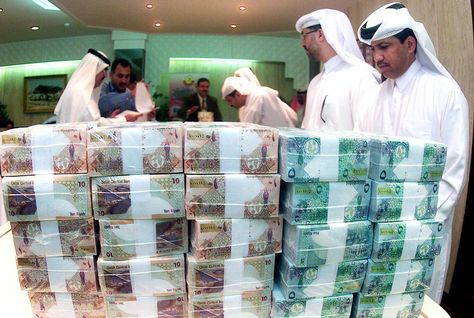
Qatari banks plan to borrow more than $6 billion to finance a construction boom ahead of the 2022 soccer World Cup as slumping oil prices constrain government deposits.
Shareholders in Al Khaliji Commercial Bank QSC approved a $2.5 billion bond program on Feb. 25, and Qatar National Bank SAQ said March 17 it arranged a $3 billion loan. Qatar International Islamic Bank may issue sukuk, or Islamic bonds, it said Feb. 19. Government deposits at Qatar’s banks more than tripled in the five years ended February 2014 before declining 4 percent the following year, central bank data show.
Qatar, a member of the Organization of Petroleum Exporting Countries, is spending $182 billion, or 90 percent of its 2013 gross domestic product, on roads, stadiums and other facilities by 2019 to play host to the World Cup. Banks will probably boost lending to $239 billion in 2018 to cater to a population that grew 9.5 percent last year, according to a Qatar National Bank report in February.
“The halving of oil has reduced government deposits, yet expectations of a significant increase in future credit demand has meant Qatari banks are seeking to raise debt,” Akber Khan, director of asset management at Al Rayan Investment, said in e- mailed comments Monday. “Banks need to go to bond markets.”
Bond Sales
Lenders in the Gulf Cooperation Council have raised $7.2 billion through bond sales this year, up from $3 billion a year earlier, according to data compiled by Bloomberg. Atiq Ur Rehman, Citigroup Inc.’s chief executive officer for the Middle East and North Africa, said in an April 7 interview that he expects “debt capital market and syndicated loan activity to be better this year.”
The average yield on bonds sold by Middle Eastern borrowers declined 21 basis points this year to 4.13 percent, according to JPMorgan Chase & Co.’s indexes. The yield on Qatar Islamic Bank sukuk maturing in 2017 is down more than 40 basis points in the period. The bank said Jan. 18 it may issue another sukuk, and Masraf Al Rayan QSC said it too is considering Islamic bonds.
Fitch Ratings upgraded seven Qatari banks in March on an “expectation of support from the Qatari authorities for domestic banks in case of need,” the agency said. Qatar Investment Authority, the country’s sovereign wealth fund, has acquired stakes ranging from 17 percent to 50 percent in each of the eight banks listed on the Doha stock exchange, according to bourse data.
Active Issuance
“Banks could be more active in issuance this year as we expect some relative weakness in local deposit markets in the Gulf region” and a “slight increase in cost of deposits,” F. Timucin Engin, director of ratings for financial institutions at Standard & Poor’s Ratings Services, said Monday in e-mailed comments.
Uncertainty about the degree of government support for banks is a concern for some investors, Fahmi Alghussein, chief executive officer of Amwal QSC, an asset manager, said Monday by phone. This uncertainty, coupled with a lack of standard rules and regulations for sukuk issues, have hindered the growth of debt markets in the region, he said.
“If we’ve learned anything from the financial crisis, it’s that there is a difference between implicit and explicit sovereign guarantees,” Alghussein said. “Unless it’s explicit, buyer beware.”
Government deposits at Qatar banks fell as crude tumbled by almost half since last year’s June peak. Qatar, the world’s largest exporter of liquefied natural gas, has faced a comparable decline in gas prices over the same period.
Borrowing costs may rise this year if the U.S. Federal Reserve raises its benchmark rate. A majority of economists in an April 3-9 Bloomberg survey forecast the first rate increase at the Fed’s September meeting.
“Qatari banks are viewed as safe-haven assets,” Ataf Ahmed, head of asset management at Doha-based QInvest LLC, said Monday by e-mail. QInvest is “likely to hold some Qatari bank sukuk as a defensive measure in our client portfolios and funds” and sees a potential increase in interest rates as the main risk to the Islamic bonds, he said.
Here we are to serve you with news right now. It does not cost much, but worth your attention.
Choose to support open, independent, quality journalism and subscribe on a monthly basis.
By subscribing to our online newspaper, you can have full digital access to all news, analysis, and much more.
You can also follow AzerNEWS on Twitter @AzerNewsAz or Facebook @AzerNewsNewspaper
Thank you!