
Asian stocks rise, oil holds gain; aussie jumps as RBA stays put
By Bloomberg
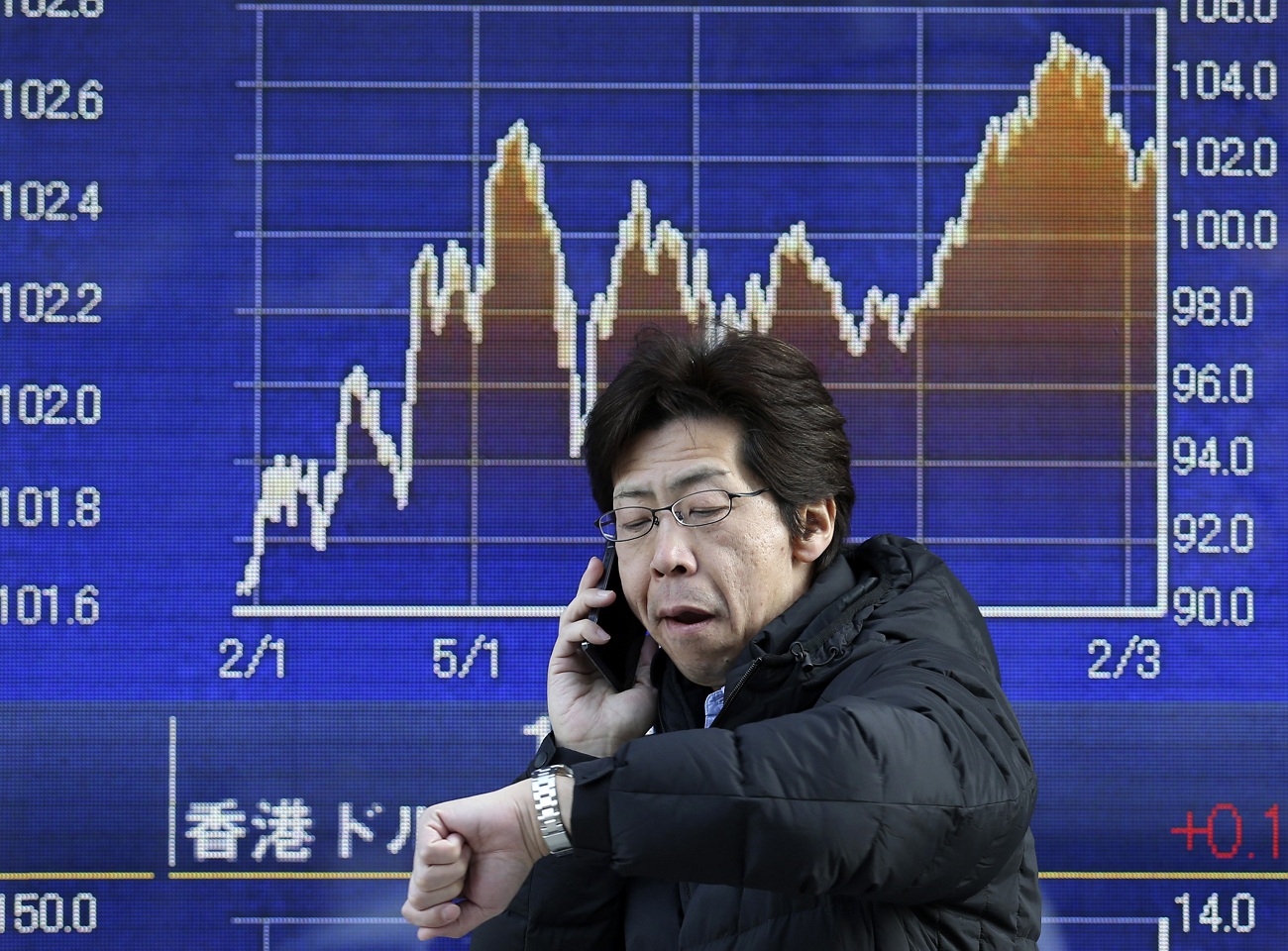
Asian stocks rose to the highest since July and crude oil traded near a six-week high. Australia’s dollar jumped as the nation’s central bank unexpectedly held rates steady.
The MSCI Asia Pacific Index added 0.5 percent by 1:40 p.m. in Tokyo, rising a fourth day as resources firms led gains. The Shanghai Composite Index added 1.8 percent. Standard & Poor’s 500 Index futures were little changed after the gauge advanced 0.7 percent Monday. U.S. oil was at $51.71 a barrel after soaring the most in two months. The Aussie surged 1.1 percent to 76.74 U.S. cents after the Reserve Bank of Australia kept the overnight cash rate at 2.25 percent.
Central banks take center stage as investors across the Asia-Pacific and Europe return from holidays, with India also deciding rates on Tuesday. Swaps traders had priced in a 77 percent chance of an Australian rate cut. The Bank of Japan meets on Wednesday before the release of the Federal Reserve’s March minutes.
“Investors appeared to support a slower Fed rate lifting regime, but this enthusiasm could be short lived as the ramifications of a lower recovery sink in,” Michael McCarthy, chief market strategist in Sydney at CMC Markets, wrote in an e- mail to clients.
Rate Bets
The yield on Australia’s three-year notes dropped as much as three basis points to 1.64 percent before the decision. Of the 30 economists polled by Bloomberg News, 17 predicted the Reserve Bank of Australia would keep the country’s overnight cash rate steady, while the rest tipped a reduction of 25 basis points.
The S&P/ASX 200 Index cut its advance in half after the RBA decision, climbing 0.5 percent in Sydney while New Zealand’s NZX 50 Index gained 0.5 percent. The Aussie is rebounding after slipping 0.5 percent Monday. The currency gained 1 percent to NZ$1.0165 after falling to a post-float low of $1.0021 last session.
The Shanghai Composite is trading at its highest levels since March 2008. The benchmark gauge for mainland China’s largest market has surged 90 percent since the end of June, boosting the value of the country’s stocks by more than $3.5 trillion.
Samsung Gains
China’s bull market will likely “go further” supported by regulated leverage tools, the China Securities Journal said in a front-page commentary written by reporter Wang Donglin and Cai Zongqi.
The Kospi index in Seoul was little changed as Samsung Electronics Co. fluctuated after jumping 2.5 percent yesterday. The Suwon, Korea-based maker of smartphones and consumer electronics reported a 5.9 trillion won ($5.4 billion) operating profit, exceeding the 5.5 trillion-won average of 36 analysts’ estimates compiled by Bloomberg. South Korea’s won dropped 0.5 percent following a four-day advance.
West Texas Intermediate crude fell 0.8 percent after soaring 6.1 percent Monday, the biggest one-day gain since Feb. 3. Brent fell 1.1 percent to $57.49 a barrel in London following a 5.8 percent surge Monday.
Copper for three-month delivery on the London Metal Exchange climbed 0.4 percent as it resumed trading for the first time since April 2. Gold was little changed at $1,214.04 an ounce following a 1 percent jump on Monday.
Yen, Euro
The Bloomberg Dollar Spot Index, a gauge of the U.S. currency versus 10 major counterparts, was little changed after a 0.3 percent gain Monday. The index slid as much as 1.1 percent in the wake of the payrolls report Friday.
The yen was steady at 119.55 per dollar, while the euro strengthened 0.1 percent to $1.0935. Yields on 10-year Treasury notes were little changed at 1.90 percent after jumping six basis points on Monday.
New York Fed President William Dudley said the pace of rate increases is likely to be “shallow” once tightening starts. The timing of the first U.S. rate increase since 2006 “will be data dependent and remains uncertain because the future evolution of the economy cannot be fully anticipated,” Dudley said Monday in New Jersey.
U.S. Economy
A report Monday showed U.S. service industries grew in March at about the same pace as in February, indicating the biggest part of the U.S. economy is holding up.
Economic reports have lagged behind analysts’ forecasts since early January, with the Bloomberg Eco U.S. Surprise Index falling to its weakest reading since 2009 last month. Minutes of the Fed’s latest meeting, after which it noted that “growth has moderated somewhat,” are due for release Wednesday.
Earnings season also gets under way this week in the U.S., with Alcoa Inc. releasing results. Analysts predict profits for S&P 500 companies fell 5.8 percent in the first quarter as earnings were buffeted by tumbling oil prices and a stronger dollar.
Investors may face the longest stretch of declines since the financial crisis, with slumps of 4.2 percent and 1 percent over the second and third quarters, the estimates show.
Here we are to serve you with news right now. It does not cost much, but worth your attention.
Choose to support open, independent, quality journalism and subscribe on a monthly basis.
By subscribing to our online newspaper, you can have full digital access to all news, analysis, and much more.
You can also follow AzerNEWS on Twitter @AzerNewsAz or Facebook @AzerNewsNewspaper
Thank you!