
Is NASA building a huge rocket to nowhere?
By Bloomberg
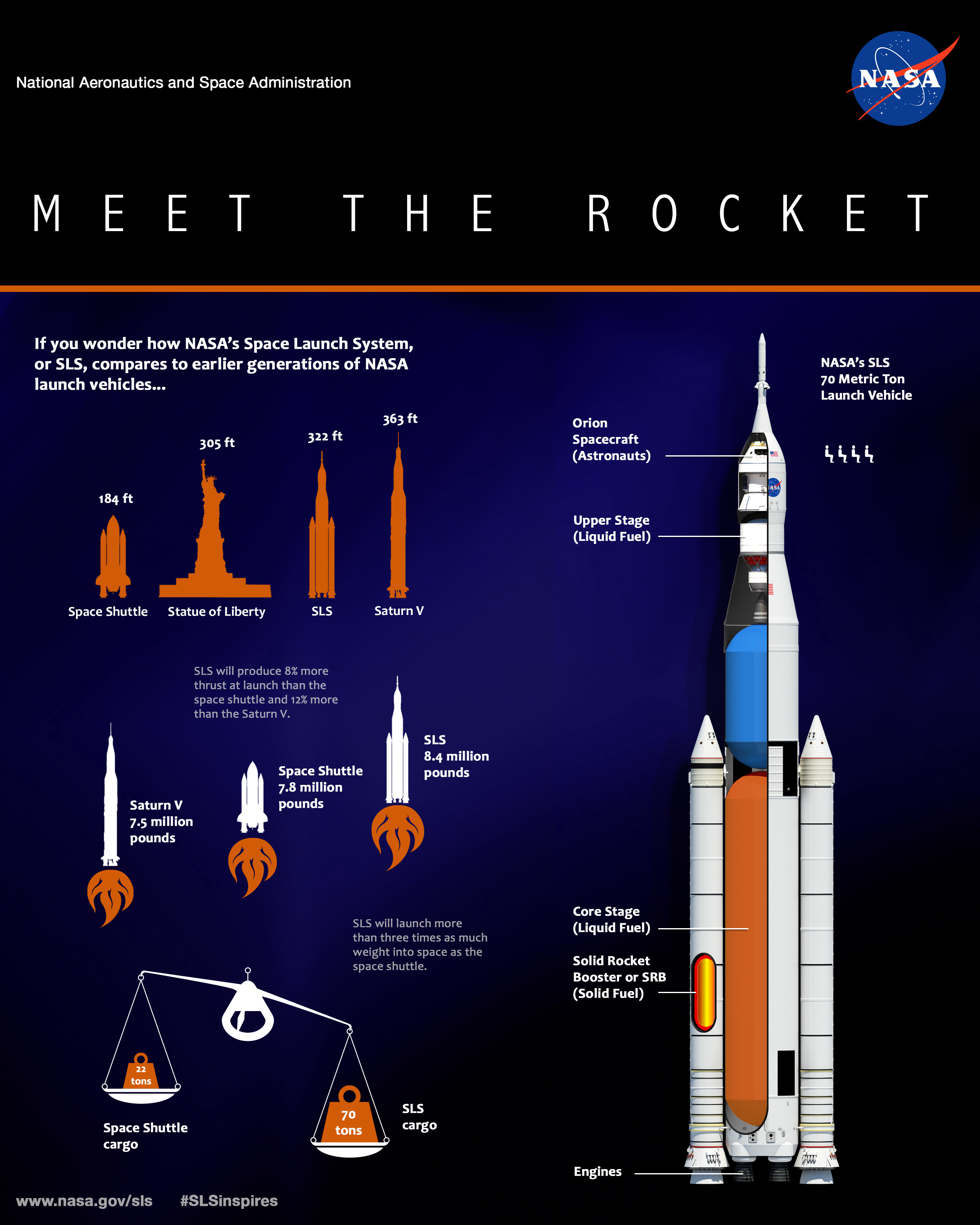
When NASA puts a human on Mars, a mission scheduled to take place from 2035 to 2040, the plan is to travel there with the aid of the largest rocket in space history. Taller than the Statue of Liberty, the Space Launch System (SLS) is an integral part of NASA’s Orion program, which plans to orbit the moon, rendezvous with asteroids, and eventually take humans to Mars.
NASA/MSFC
In many respects, the SLS has become to Orion what NASA’s massive Saturn V rocket was to the Apollo lunar missions—an expensive symbol of NASA’s engineering leadership. (The SLS's basic specs(PDF) are similar to those of the Saturn V, but the SLS will provide more thrust.) Yet critics are quick to note that, unlike during the Apollo era, NASA’s budget is now severely constrained; several promising private ventures may be able to lift heavy things into orbit at a fraction of what Uncle Sam is spending. Moreover, they contend, this strain on the budget crimps vital research on the long list of additional technical obstacles impeding human travel to Mars.
“If you look at the timeline for going to Mars, they keep talking about 25 years out—and it’s 25 years out because of their budgets and because they keep spending it on their huge rocket at ridiculously higher prices than the private market,” says Henry Vanderbilt, executive director of the Space Access Society, a research group that advocates for lower-cost approaches to space travel. “You can make the argument that with that rocket as a drag on NASA’s budget, we’re never going to be at Mars."
NASA is giving the SLS project a public display on Wednesday, when contractor Orbital ATK plans a two-minute test firing of the SLS’s solid rocket booster in Utah, a key step in the program’s development. The rocket’s two boosters are an enlarged version of those that flew on the Space Shuttle missions; they were cribbed from that program partly in response to tight budgets. The SLS also uses four RS-25 engines, the same model that powered the Space Shuttle. (NASA has dubbed the RS-25 the “Clark Kent of engines.”)
“Do we really think that technology from the 1970s is what we should be going to Mars with? It boggles my mind,” says Lori Garver, NASA’s former deputy administrator and a long-time critic of the SLS. “Let the transport part be handled by the private sector.”
The initial version of the SLS is designed to carry 70 metric tons and fly for the first time in late 2018, when it will transport an unmanned Orion capsule on a mission around the moon and back. The first manned Orion-SLS flight is currently set for 2021 and will entail a mission around the moon for as long as 10 days, with several lunar orbits. Later versions will boost the rocket’s lift capacity to 130 metric tons, enabling the trip to Mars and potentially, to other destinations.
The program that preceded the SLS-Orion plan, called Constellation, started under President George W. Bush and was designed to return Americans to the moon by 2020, the initial step in the country’s path to Mars. President Barack Obama canceled the program in 2010 after a commission found that NASA’s budgets wouldn't support Constellation’s ambitions. But NASA spent heavily on a new Ares rocket during the six years of Constellation work, and backers of a NASA-built rocket found support among some U.S. senators, which led critics to dub the SLS the “Senate Launch System.” In January, Congress approved $1.7 billion for the SLS—$320 million more than Obama had requested—as part of an $18 billion NASA budget for 2015.
Bill Hill, NASA’s deputy associate administrator for exploration systems development, argues that the government’s investment in a heavy lift rocket is critical, given the uncertainties around such development in the private sector.
“Do you believe promises or do you believe what hardware is actually built and ready to go?” asks Hill, who contends that companies such as SpaceX, Jeff Bezos's Blue Origin, and Orbital ATK need NASA as a major client in order to pursue heavy lift designs. NASA has also shared a large body of propulsion research data with private players in the rocket business, Hill says. “There’s an impression that the commercial guys are basically paying their own way … but if you dug into it, you may find that is not necessarily the case.”
Others share that view. “We can’t kid ourselves—there’s no market for Mars,” says Jason Davis, an editor with the Planetary Society, which advocates space exploration. “We’re just now seeing a market develop for low-earth orbit, and right now it’s almost entirely dependent on NASA. When it comes to something like Mars, NASA has to be the trailblazer for it.”
SpaceX founder Elon Musk is planning a “heavy” version of the company’s Falcon rocket to carry 53 metric tons into space. SpaceX has been working to make its rockets reusable, with quick turnaround between flights allowing more trips and lower operational costs. The RS-25 engines on the SLS, in contrast, can be used only once. NASA has 16 engines and plans to acquire an additional six. “As long as we continue to throw away rockets and spacecraft, we will never have true access to space,” Musk said in May 2014. “It will always be incredibly expensive.”
Hill says NASA is working to lower the expense of each engine and make SLS flight costs “competitive with other folks in the market,” as well as making a vehicle that could be used for military and other launch customers. “That’s our mantra right now” for the SLS program, Hill says. “And if we can’t, then it’s not going to sustain itself. And NASA will be the only customer.”
Here we are to serve you with news right now. It does not cost much, but worth your attention.
Choose to support open, independent, quality journalism and subscribe on a monthly basis.
By subscribing to our online newspaper, you can have full digital access to all news, analysis, and much more.
You can also follow AzerNEWS on Twitter @AzerNewsAz or Facebook @AzerNewsNewspaper
Thank you!