
Russian manufacturing contraction eases unexpectedly last month
By Bloomberg
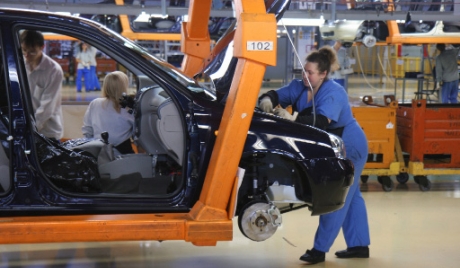
Russia’s manufacturers fared better in February than forecast as a contraction eased for the first time in three months after a weaker ruble and President Vladimir Putin’s ban on food spurred local production.
The Purchasing Managers’ Index climbed to 49.7 in February from 47.6 in January, according to data released by HSBC Holdings Plc and Markit Economics on Monday. The median estimate of eight economists surveyed by Bloomberg was 47. A reading below 50 signals contraction.
The world’s biggest energy exporter is entering its first recession since 2009 as oil prices trade at a six-year low, compounding penalties imposed by the U.S. and its allies over Russia’s role in the Ukrainian conflict. While the economy is forecast to contract 3 percent this year, the Kremlin’s retaliatory food import ban may boost output in some industries, according to the Economy Ministry.
“Stronger domestic demand boosted Russian manufacturing output in February, with import substitution reported to have played a role,” Trevor Balchin, a senior economist at Markit, said in the statement. “In contrast, new export business declined for a survey-record 18th successive month, and at a faster pace.”
While industrial output is seen falling 1.6 percent this year, food industry and agriculture will grow due to import substitution, the Economy Ministry said in its forecast, based on an average ruble rate of 61.5 to the dollar and oil at $50 per barrel.
After a 46 percent collapse last year, the ruble began gaining against the dollar in January and strengthened almost 12 percent last month, the best performance among more than 170 currencies tracked by Bloomberg.
Inflation, which soared to 15 percent in January, the fastest in almost seven years, will peak in the second quarter, Bank of Russia Governor Elvira Nabiullina said in an interview Feb. 9. The higher readings are the result of past factors, such as ruble depreciation, and the central bank sees no significant factors leading to further acceleration.
“The other key finding from the February survey was the slower rate of input price inflation which, although still severe, was the weakest since October and reflective of the ruble’s recent rally,” said Balchin.
Here we are to serve you with news right now. It does not cost much, but worth your attention.
Choose to support open, independent, quality journalism and subscribe on a monthly basis.
By subscribing to our online newspaper, you can have full digital access to all news, analysis, and much more.
You can also follow AzerNEWS on Twitter @AzerNewsAz or Facebook @AzerNewsNewspaper
Thank you!