
Here’s the U.K. election result bookmakers say: more Cameron
By Bloomberg
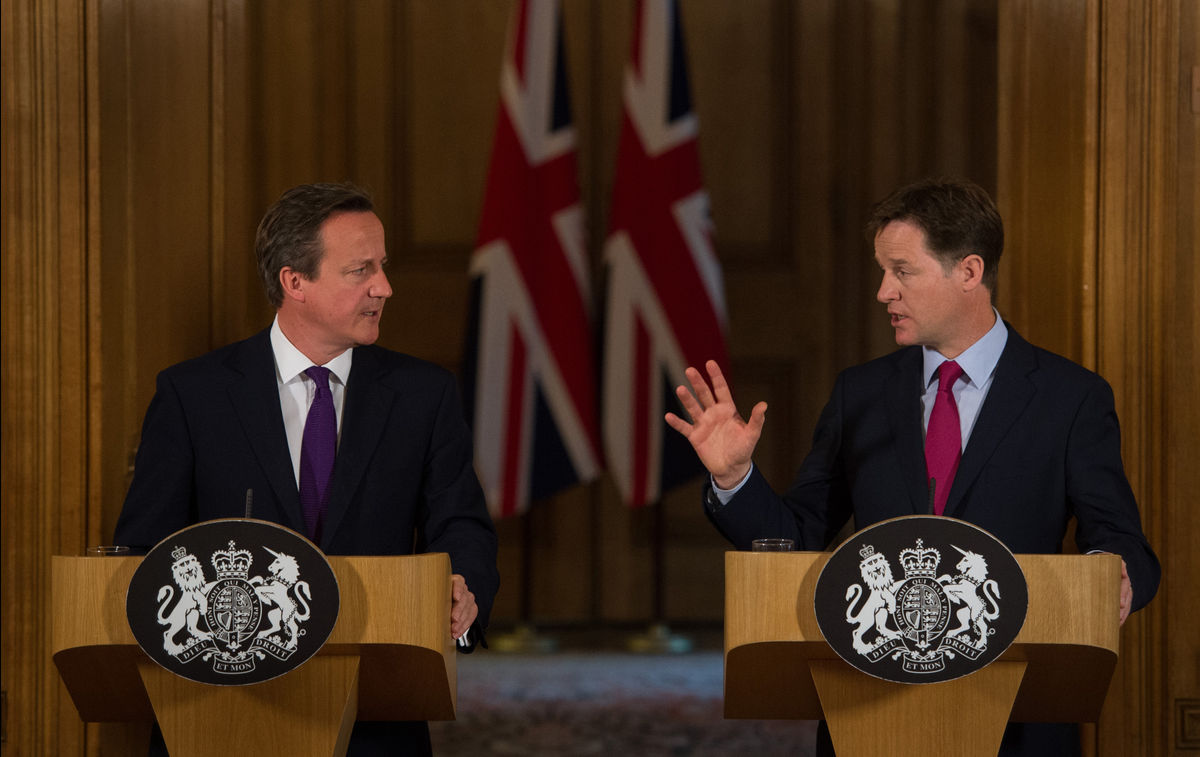
On the morning of May 8, David Cameron will stroll back through the door of Number 10 Downing Street, with Nick Clegg behind him, after securing another election win and a second term as British prime minister.
At least, that’s according to gamblers wagering with the U.K.’s bookmakers and betting exchanges. Odds signal that a second term for the Conservatives and Liberal Democrats is the most likely outcome of the May 7 general election, albeit by a slim margin, according to Oddschecker.com, a price comparison website that tracks more than two dozen betting companies.
History suggests that financial traders trying to figure out the shape of the next U.K. government should pay attention to these markets. So certain was Betfair Group Plc of the outcome of the Scottish independence referendum last year, it paid out on a “no” vote two days before the ballot even after polls suggesting a tight contest had sent the pound tumbling.
“If people want to know how the U.K. election is going to go, all they have to do is look at the betting markets,” Leighton Vaughan Williams, an economics professor at Nottingham Trent University, said in an interview last week. “They’d be silly to be surprised by the outcome.”
Growing Market
Political gambling is gaining ground. At least 40 million pounds ($62 million) will be bet on the general election, according to Vaughan Williams, who runs the Betting Research and Political Forecasting unit at the university.
That’s four times more than 10 million pounds gambled on the 2010 election, which put the Conservatives and Liberal Democrats into power after 13 years of Labour rule. It was the first coalition government since World War II after a so-called hung parliament produced no clear winner.
William Hill Plc said last week that a punter had wagered 200,000 pounds, the biggest general election bet ever, on another hung parliament. The same bettor won 193,000 pounds after placing 900,000 pounds on the outcome of the Scottish referendum, according to William Hill, who didn’t name the man.
Customers using Betfair’s exchange would trade about 40 million pounds on a later-stage Grand Slam tennis match, according to the company. A Premier League soccer game draws at least 20 million pounds. Betfair, which allows gamblers to bet against each other on its exchange, saw 21 million pounds traded on the Scottish referendum in September.
Tight Vote
“In politics, where people are betting what they want to happen, there are huge opportunities for people like me,” said Peter Smith, 66, a regular punter from London who gambles with a portion of the money he received when he lost his job as a tax adviser. “It has proved by far the best of my investments, by a very long way.”
Of the 12 most recent polls, 10 have shown Labour ahead, albeit mostly within the margin of error. A YouGov/Sun poll published on Tuesday showed Labour at 34 percent, one percentage point ahead of the Conservatives, and a TNS poll published Wednesday put Labour ahead by seven points.
Yet in gambling markets, the most likely election outcome is a continuation of the Conservative-Liberal Democrat grouping, with the Liberals odds on to retain party leader Nick Clegg’s seat, according to William Hill.
Comparison website Oddschecker.com shows the odds of this outcome, over nine betting firms, at about 4-to-1, meaning a bet of a pound wins four pounds. A Labour minority government is just behind at about 5-to-1.
At the same point before the last election in 2010, odds collator Politicalbetting.com predicted a majority for the Conservatives of 36 seats. They ended up with 307 seats, or 19 short of a winning total. Bookmakers can also disagree, with one firm making any coalition involving the Liberal Democrats marginal favorite, over a continuation of the current grouping.
Old Tradition
“Where betting markets tend to be stronger is on government formation in a hung parliament,” said Chris Hanretty of the University of East Anglia, who is part of a team that prepares election forecasts. “They can take into account softer factors, like chemistry between party leaders and policy overlap, which matter when forming a coalition.”
Betting on political outcomes dates back to at least the 16th century when Roman merchants and Vatican officials wagered on papal elections, according to Paul Rhode and Koleman Strumpf, economics professors at Michigan and Kansas universities who have researched the history and accuracy of political gambling.
So-called spread-betting emerged in the U.K. in the early 20th century when traders in London placed wagers on the size of a party’s parliamentary majority, rather than just predicting the victor, they said.
For Peter Smith, the key to political betting is closely studying the market as others would a horse race, removing instinct and emotion.
Smith said he won about 11,000 pounds betting on Barack Obama to become U.S. president in 2008. For the next U.S. presidential election, Hillary Clinton is the overwhelming favorite, according to Oddschecker.com.
Back in the U.K., Smith has now gambled about 8,000 pounds across 200 separate bets on the election.
“It’s relatively easy money,” said Smith. “If there were enough markets, I’d never bet on anything but politics.”
Here we are to serve you with news right now. It does not cost much, but worth your attention.
Choose to support open, independent, quality journalism and subscribe on a monthly basis.
By subscribing to our online newspaper, you can have full digital access to all news, analysis, and much more.
You can also follow AzerNEWS on Twitter @AzerNewsAz or Facebook @AzerNewsNewspaper
Thank you!