
Lira slump blunting oil-soaked optimism on rates: Turkey credit
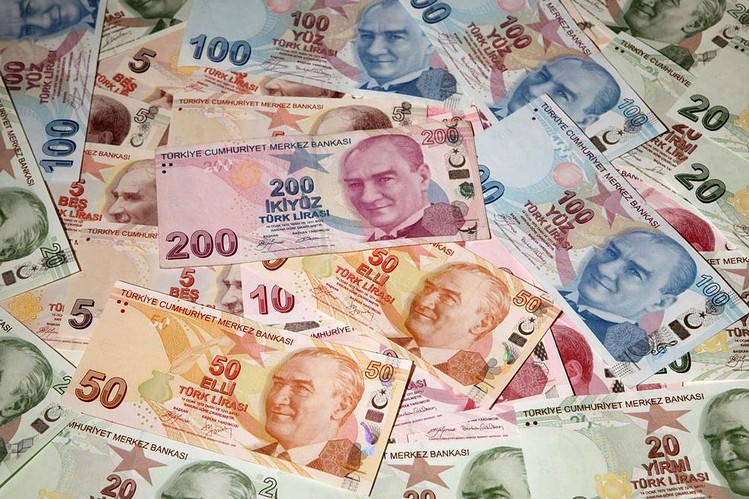
By Bloomberg
The slumping Turkish lira is complicating the calculations of central bank Governor Erdem Basci as he confronts mounting political pressure to speed up the pace of interest-rate cuts.
While a more than 50 percent slide in crude prices since June has helped cool consumer-price growth to the slowest in almost two years, the lira’s drop to successive records this month is undoing some of oil’s work. Faced with ever more intensive calls from President Recep Tayyip Erdogan to reduce borrowing costs, Basci needs inflation to keep moderating to justify faster reductions and maintain market credibility.
As calls by the government grow louder, analysts are questioning how pronounced the drop in inflation will be. Each 10 percent slide in the lira translates into as much as a 1.5 percentage-point increase in consumer-price growth, according to Standard Chartered Plc. The currency has weakened more than 7 percent in the past month.
“The lira’s decline is definitely slowing the pace of the drop in inflation,” Henrik Gullberg, a currency strategist at Deutsche Bank AG in London, said by e-mail Thursday. “It means that imported inflation will be higher than otherwise would be the case, and that reduces Basci’s room for rate cuts.”
Erdogan has repeatedly insisted, against conventional economic wisdom, that higher interest rates are stoking inflation, and said Feb. 8 that Basci will be held accountable for monetary policy that’s “not right.”
Damaged Credibility
Amid criticism from Erdogan and his political allies, Basci kept monetary policy tied to consumer prices, waiting six months for signs of a weakening inflationary trend before cutting the benchmark one-week repurchase rate by 50 basis points to 7.75 percent last month.
Basci said he would hold an emergency rates meeting last week if inflation fell by one percentage point or more in January, prompting some analysts to say that he was too willing to accommodate the government. Consumer-price inflation slowed by 0.93 percentage point to 7.24 percent last month, the lowest level since May 2013, and the meeting was never held.
The central bank next meets on interest rates on Feb. 24.
“The problem for the central bank governor is that he has rationalized his politically induced rate-easing cycle on the basis of decreasing inflationary pressures,” Philippe Dauba- Pantanacce, an economist at Standard Chartered in London, wrote in an e-mailed report Wednesday. “A depreciating lira could slow this down and the inflation trend might not correct as much as hoped.”
Risk Premium
Policy makers cut their year-end inflation forecast to 5.5 percent from 6.1 percent on the back of falling oil prices, according to the central bank’s quarterly inflation report published Jan. 27.
Having fallen as much as 57 percent from June, Brent crude has risen about 32 percent in the past month in lira terms as oil rebounded and the Turkish currency dropped.
Turkey’s currency rebounded yesterday after Deputy Prime Minister Ali Babacan said in interview with state-run news channel TRT that comments on decisions by the central bank’s monetary policy committee reduce predictability and raise Turkey’s risk premium.
The lira rose 1.3 percent to 2.4683 to the dollar at 6:29 p.m. Thursday in Istanbul, trimming its decline over the past month to 7.4 percent. It weakened to a record 2.5149 on Feb. 11.
Even as Turkish bonds rose Thursday, concern about political interference in monetary policy and the slide in the lira have hurt pushed up yields 1.23 percentage points in the past two weeks.
Inflation Expectations
Still, inflation expectations as measured by the 10-year break-even rate are at 5.7 percentage points, after reaching a 2 1/2-year low 5 percentage points in January.
As long as the central bank can keep inflation expectations under control, the “pass-through effect should be relatively contained,” Simon Quijano-Evans, the head of emerging-market research at Commerzbank AG in London said by e-mail. “The problem though is that each time the lira recovers, noise around central bank rates increases again.”
Here we are to serve you with news right now. It does not cost much, but worth your attention.
Choose to support open, independent, quality journalism and subscribe on a monthly basis.
By subscribing to our online newspaper, you can have full digital access to all news, analysis, and much more.
You can also follow AzerNEWS on Twitter @AzerNewsAz or Facebook @AzerNewsNewspaper
Thank you!