
Europe stocks drop with Greek bonds as gold gains; ruble jumps
By Bloomberg
European stocks fell with Greek and Portuguese bonds, while Treasuries climbed with gold after Greece’s prime minister reaffirmed his rejection of the nation’s bailout. Russia’s ruble rallied as the central bank predicted inflation will peak in the second quarter.
The Stoxx Europe 600 Index slid 1.2 percent by 8:20 a.m. in London, retreating from a seven-year high. Standard & Poor’s 500 Index futures sank 0.5 percent. The yield on 10-year U.S. notes fell five basis points while rates on similar Greek notes jumped more than 30 basis points. Gold increased 0.5 percent. Russia’s ruble strengthened 2.7 percent. The Hang Seng Index lost 0.6 percent after Chinese imports plunged. Brent crude slipped after its biggest two-week advance in 17 years.
Greek Prime Minister Alexis Tsipras vowed to negotiate an end to austerity before talks with creditors, while Russia’s foreign minister warned the U.S. and its allies against sending weapons to Ukraine. The biggest import slump in more than five years pushed China’s January trade surplus to a record, highlighting the impact of lower commodity prices. U.S. payrolls topped estimates, data Friday showed, boosting odds of an interest-rate increase in the first half of 2015.
“The Greek and Ukrainian situation is making Europe quite chaotic,” said Shoji Hirakawa, chief equity strategist at Okasan Securities Co. in Tokyo. “The extreme rhetoric from Greek authorities won’t abate worries about a Grexit. Aside from that, the potential for the U.S. to begin providing arms to Ukraine is making the outlook very uncertain.”
U.S. Futures
European shares retreated after the Stoxx 600 closed at its highest level since December 2007 on Friday. Oil and gas firms climbed today, while airlines were weaker after crude’s recent rebound.
Contracts on the Dow Jones Industrial Average and the Nasdaq 100 index fell 0.5 percent. Futures are signaling the world’s biggest equity market may decline further after the S&P 500 retreated from near record levels to finish lower on Friday.
U.S. stocks reversed early gains Friday as S&P cut its rating on Greek debt and warned that liquidity constraints meant that the timeframe for a new agreement with the country’s creditors had been shortened. Losses deepened amid reports that Greece was given until Feb. 16 to apply for a bailout.
Tsipras vowed on Sunday to increase the minimum wage, restore the income tax-free threshold and halt infrastructure privatizations in a speech that sets him on a collision course with the country’s creditors. Finance Minister Yanis Varoufakis faces his 18 euro-area counterparts on Feb. 11 at an emergency meeting in Brussels.
Yields on 10-year Treasuries retreated to 1.92 percent after jumping 14 basis points in New York at the end of last week. The rate on Germany’s 10-year notes was two basis points lower at 0.35 percent.
Yields Surge
The rate on Greece’s February 2024 notes climed 33 basis points to 10.7 percent, while 10-year yields in Portugal, Italy and Spain increased at least three basis points.
Gold, regarded with the yen as a haven investment and hedge against inflation, climbed to $1,239.96 an ounce, after its worst weekly performance since October. The yen strengthened 0.3 percent to 118.77 per dollar and the euro added 0.3 percent to $1.1348 after plunging 1.4 percent Friday.
Companies in the U.S. added 257,000 workers last month, following a 329,000 gain in December that was bigger than previously reported. The median forecast in a Bloomberg survey of economists called for a 228,000 increase in January. The U.S. unemployment rate climbed to 5.7 percent.
Australia’s S&P/ASX 200 Index closed 0.1 percent lower after a record 12-day rising streak. The Aussie dropped to 77.85 U.S. cents, while Australian 10-year debt yielded 2.54 percent, up nine basis points. Yields on similar maturity Japanese bonds rose 1 1/2 basis points to 0.355 percent.
Hang Seng
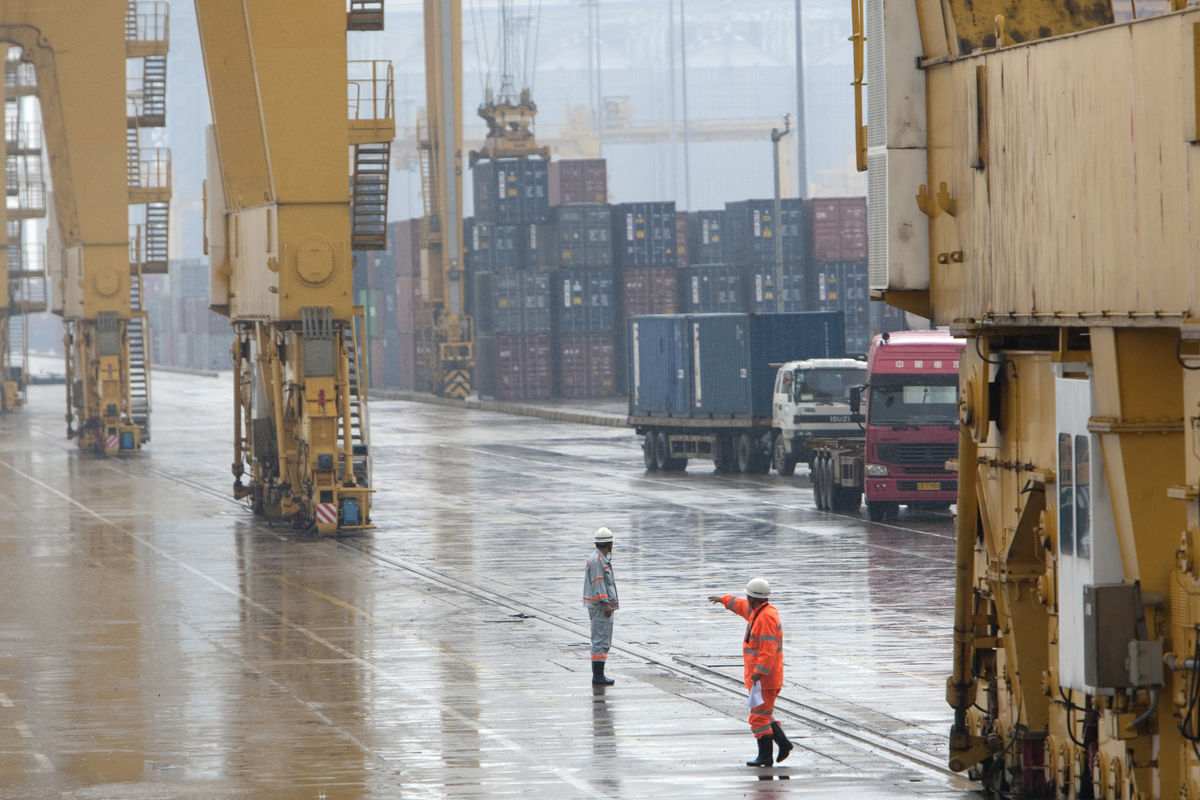
China’s imports plunged 19.9 percent from a year earlier, the customs administration in Beijing said Sunday. That compared with estimates for a 3.2 percent drop in a Bloomberg survey of analysts. Exports slid 3.3 percent, leaving a trade surplus of $60 billion.
The Shanghai Composite Index swung to a gain of 0.6 percent amid speculation recent market losses were excessive and the start of options trading will boost demand for large-cap shares.
Hong Kong’s Hang Seng Index dropped and a gauge of Chinese shares in the city slipped 0.4 percent, paring a loss of as much as 1.3 percent. Shares of Kaisa Group Holdings Ltd. jumped 18 percent as they resumed trading after Sunac China Holdings Ltd. offered to buy the developer, helping to avoid the first default on a dollar bond by a Chinese developer. Sunac climbed 3.6 percent.
Leaders of Germany, France, Ukraine and Russia -- the world’s biggest energy exporter -- plan to meet in Minsk, Belarus on Feb. 11 for talks on a peace agreement amid ongoing violence in Ukraine. Russian President Vladimir Putin has said all sides must first agree on their positions before discussions can take place.
Russia Inflation
“Markets have already discounted the situation and are considering that the worst is behind and this will not deteriorate further,” said David Gaud, a Hong Kong-based senior portfolio manager and global investment specialist at Edmond de Rothschild Group, which oversees about $151 billion.
The ruble rose to 66.24 per dollar, after the currency slipped 0.6 percent on Friday. Russia’s central bank is unlikely to reverse last month’s surprise rate cut as inflation is set to slow after it accelerated to the fastest in almost seven years, according to Governor Elvira Nabiullina.
In India, the S&P BSE Sensex slid 1 percent, poised for the lowest level since Jan. 19 and a seventh straight drop. Six of seven exit polls after voting ended in Delhi elections predict a defeat for Prime Minister Narendra Modi’s Bharatiya Janata Party.
Rupee, Bonds
India’s rupee slid 0.7 percent to 62.1137 per dollar. The yield on Indian government bonds due July 2024 rose two basis points, or 0.02 percentage point, to 7.72 percent, prices from the central bank’s trading system show.
Brent crude traded at $57.69 a barrel, up more than 20 percent from an almost six-year low reached Jan. 13. Brent surged 18 percent in the 10 trading days to Feb. 6, the most since March 1998, though it is still down almost 50 percent from a high reached in June.
West Texas Intermediate oil rose 0.4 percent to $51.93 a barrel in New York following a weekly gain of 7.2 percent. The contract has rebounded on speculation a declining rig count in the U.S. is signals output will slow. Price volatility rose to the highest level in almost six years on Friday.
Here we are to serve you with news right now. It does not cost much, but worth your attention.
Choose to support open, independent, quality journalism and subscribe on a monthly basis.
By subscribing to our online newspaper, you can have full digital access to all news, analysis, and much more.
You can also follow AzerNEWS on Twitter @AzerNewsAz or Facebook @AzerNewsNewspaper
Thank you!