
China’s stocks rise as consumer staples rally with financials
By Bloomberg
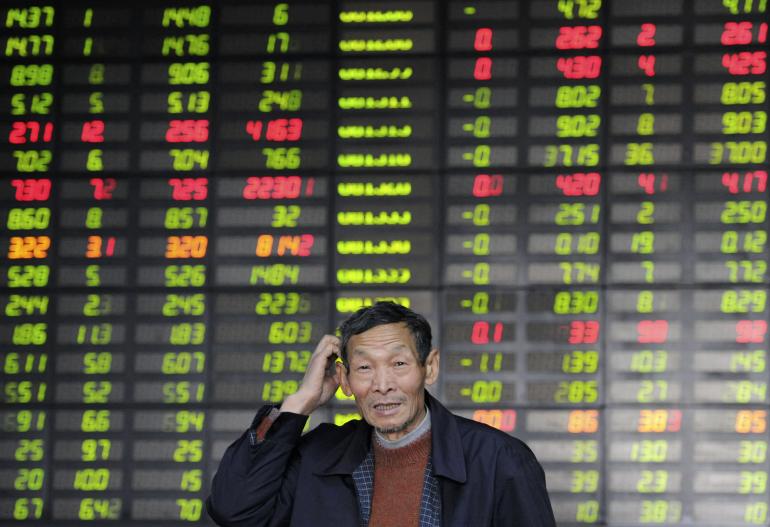
China’s stocks rose for the first time in four days, led by financial and consumer-staples companies, amid speculation recent market losses were excessive and the start of options trading will boost demand for large-cap shares.
China Life Insurance Co. and Western Securities Co., which reported a jump in profit last month, surged more than 5 percent to pace gains for financial shares. Liquor producer Kweichow Moutai Co. jumped 5.6 percent on prospects for increased sales before the start of the Chinese New Year next week.
The Shanghai Composite Index added 0.6 percent to 3,095.12 at the close, erasing a loss of as much as 0.9 percent. Mainland stocks fell earlier after data over the weekend showed imports falling by the most in more than five years in January and export growth trailing estimates. A cut in banks’ reserve-ratio requirements this month failed to soothe concern that the world’s second-biggest economy is slowing. Recent data showed manufacturing gauges signaling a contraction, while a gauge of services expanded at the weakest pace in six months.
“The economy isn’t that good but on the other side, we may soon see the central bank loosening monetary policies again,” said Wang Weijun, a strategist at Zheshang Securities Co. in Shanghai.
Before Monday’s trading, the Shanghai gauge had fallen eight of the last nine trading days, sending valuations to 11.6 times 12-month projected earnings, the lowest level since Dec. 24. The measure has slid 4.3 percent this year after rallying 53 percent in 2014 for the world’s best-performing equity gauge.
Trade Data
The CSI 300 Index rose 1 percent on Monday, while Hong Kong’s Hang Seng China Enterprises Index slid 0.4 percent and the Hang Seng Index lost 0.6 percent. The Chinese new year holiday starts Feb. 18 and last for a week.
Imports fell 19.9 percent from a year earlier, the customs administration in Beijing said Sunday. That compared with estimates for a 3.2 percent drop in a Bloomberg survey of analysts. Exports slid 3.3 percent, leaving a trade surplus of $60 billion. Overseas shipments trailed the median estimate of a 5.9 percent increase.
“The slump in imports means a slump in the overall situation of the economy,” Hu Yifan, chief economist at Haitong International Securities Group Ltd., said yesterday in Hong Kong. “We are going to see more of these alarming data in the next few months.”
Options Trading
Contracts on the China 50 ETF, an exchange-traded fund tracking some of the country’s biggest companies, began changing hands on the Shanghai Stock Exchange as part of a trial that Haitong Futures Co. predicts will eventually expand to options on equity indexes and single stocks. It’s the first new equity derivative allowed by Chinese regulators since the 2010 introduction of index futures, a market that has grown about 10- fold in the past four years.
“As large-cap financial stocks have a big weighting in the ETF, their discounts to small-caps may narrow,” said Qiu Dongrong, a Shanghai-based money manager at HSBC Jintrust Fund Management Co. His $247 million large-cap fund has beaten 83 percent of peers tracked by Bloomberg during the past year.
Gauges of financial and consumer-staples companies in the CSI 300 rose at least 1.9 percent, the most among 10 industry groups. Wuliangye Yibin Co., the second-biggest producer of baijiu liquor after Moutai, added 1.7 percent.
Western Securities surged 10 percent. The company posted a profit of 186.8 million yuan in January, up 314 percent from a month earlier. Combined net profits of 20 listed brokerages totaled 8.11 billion yuan in January, the Xinhua News Agency reported, citing data from the Shanghai and Shenzhen bourses. Soochow Securities Co. climbed 9.8 percent. China Life Insurance advanced 5.9 percent.
Shenzhen Link
Margin traders increased holdings of shares purchased with borrowed money for a third day on Feb. 6, with the outstanding balance of margin debt on the Shanghai Stock Exchange rising 0.2 percent to a record 779.6 billion yuan ($124.8 billion).
Hong Kong Chief Executive Leung Chun-ying hopes the Shenzhen-Hong Kong stock connect will begin in the second half of this year, he told a business group on Monday.
While no start date has been set for the link, investors anticipate the connect will allow foreign investors to access Shenzhen’s largest companies. Premier Li Keqiang has given his blessing for a link, the Shenzhen Special Zone Daily reported on its website Jan. 5. The basic framework will be the same as the Hong Kong-Shanghai connect, the Shenzhen Stock Exchange said in a Feb. 2 statement.
Twenty-four companies will start to sell initial public offering shares this week, with three on Monday. The sales may freeze 2.05 trillion yuan, according to the median estimate of nine brokerages in a Bloomberg survey.
Here we are to serve you with news right now. It does not cost much, but worth your attention.
Choose to support open, independent, quality journalism and subscribe on a monthly basis.
By subscribing to our online newspaper, you can have full digital access to all news, analysis, and much more.
You can also follow AzerNEWS on Twitter @AzerNewsAz or Facebook @AzerNewsNewspaper
Thank you!