
Asian stocks slip, led by China, as dollar advances with bonds
By Bloomberg
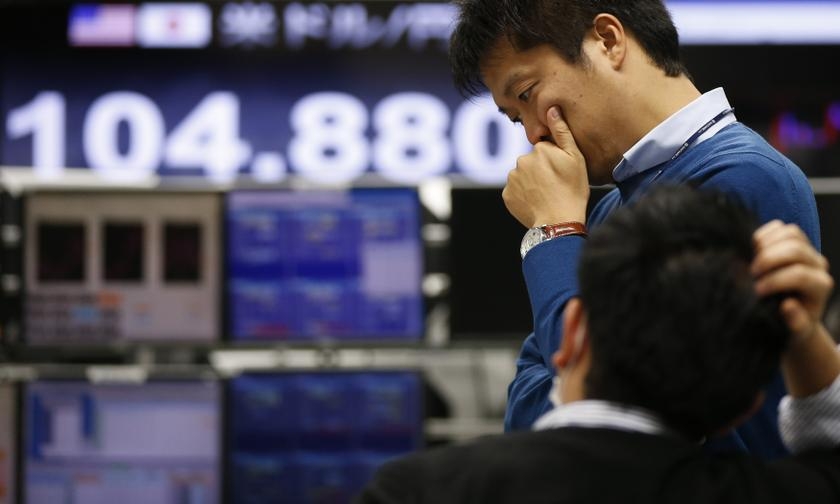
Asian stocks fell, led by Chinese shares as regulators increased scrutiny of margin loans, while the dollar rallied against most peers after the Federal Reserve upgraded its view of the U.S. economy. Oil traded near an almost six-year low and bonds in the region rallied.
The MSCI Asia Pacific Index dropped 1.1 percent by 2:59 p.m. in Tokyo, as the Hang Seng China Enterprises Index retreated 2.4 percent. Dow Jones Industrial Average futures fluctuated after the index’s biggest two-day drop in almost a year. The Bloomberg Dollar Spot Index climbed toward a record as the euro weakened 0.2 percent. Ten-year Australian bond yields slipped to a record low. Crude traded at $44.42 a barrel in New York.
Chinese regulators are probing the margin lending that’s helped drive the benchmark Shanghai Composite Index up 47 percent since the end of August. Oil’s bear market is damping inflation prospects and spurring worldwide monetary easing, with New Zealand’s central bank the latest to hint its next move could be a rate cut. The Federal Reserve maintained a pledge to be “patient” on raising benchmark borrowing costs, citing risks to the U.S. economy from an international slowdown.
China’s market regulators “sent a signal that they don’t feel comfortable,” said Yuliang Chang, Hong Kong-based strategist at Deutsche Bank AG. The pace of growth in margin lending and umbrella trusts “is creating a systemic risk in the financial industry,” he said.
The Shanghai Composite slipped 1.2 percent and the CSI 300 Index, which tracks shares in Shanghai and the southern city of Shenzhen, dropped 1.1 percent. Hong Kong’s Hang Seng Index, which closed at a four-month high this week, retreated 1.2 percent.
Fed Commentary
Regulators will assess a remaining 46 firms, after an initial 45 were checked, Xinhua News Agency reported. The China Securities Regulatory Commission said the checks were routine and shouldn’t be over-interpreted, Xinhua reported. Margin debt increased to a record 773.8 billion yuan on the Shanghai exchange Tuesday after a tenfold increase during the past two years.
The Swiss franc weakened 0.7 percent to buy $1.0972 and 97.38 euro cents. The euro was at $1.1269, while the Dollar Spot Index climbed 0.2 percent to 1,162.45, heading for its highest close since at least 2005. The dollar was stronger against 12 of 16 major peers.
The Fed acknowledged global risks in its statement, saying that it will take into account readings on “international developments” as it decides how long to keep key rates near zero. Surprisingly strong job gains argue for tightening sooner, while inflation held down by the plunge in oil prices and a cooling global economy provides grounds for delay.
Aussie Bonds
Ten-year Treasury yields were little changed after dropping 10 basis points, or 0.10 percentage point, to 1.72 percent on Wednesday. Thirty-year yields reached a record low.
Rates on Australian government debt due in a decade fell as much as 13 basis points to an all-time low of 2.47 percent. Similar maturity New Zealand yields slipped 15 basis points to 3.17 percent as the so-called kiwi bought 73.32 U.S. cents. New Zealand’s central bank shifted to a neutral stance on interest rates and hinted it’s prepared to lower them.
The Kospi index declined 0.4 percent in Seoul, while Australia’s S&P/ASX 200 Index climbed 0.3 percent. Japan’s Topix index dropped 1.1 percent, while the yen retreated 0.1 percent to 117.65 per dollar.
West Texas Intermediate crude was little changed after sinking 3.9 percent on Wednesday. Data showing U.S. oil supplies rose the highest level in more than 30 years fueled the declines. Brent added 0.3 percent to $48.59 a barrel in London after a 2.3 percent drop yesterday.
Ringgit, Grains
Malaysia’s ringgit depreciated to 3.6345 per dollar, the weakest level for the oil-exporting country’s currency since April 2009.
Wheat extended its biggest daily decline in more than a month, falling 0.2 percent to $5.0425 a bushel to trade near the lowest level since October. Corn dropped 0.2 percent to $3.725 a bushel, the lowest level in more than two months. Soybeans are trading near their lowest since October.
Global grain inventories excluding rice will rise about 7 percent to 432 million metric tons by the end of the 2014-2015 season, the highest since the mid-1980s, the International Grains Council said on Jan. 22.
Copper for delivery in three months slid 1 percent to $5,430 a metric ton on the London Metal Exchange. The metal is heading for its biggest monthly loss since September 2011. Nickel retreated 1.3 percent.
Here we are to serve you with news right now. It does not cost much, but worth your attention.
Choose to support open, independent, quality journalism and subscribe on a monthly basis.
By subscribing to our online newspaper, you can have full digital access to all news, analysis, and much more.
You can also follow AzerNEWS on Twitter @AzerNewsAz or Facebook @AzerNewsNewspaper
Thank you!