
U.K. consumers push back against drag from european weakness
By Bloomberg
British exporters are taking a knock from the sluggishness of the euro area, leaving consumers fueling much of the fire behind the expansion.
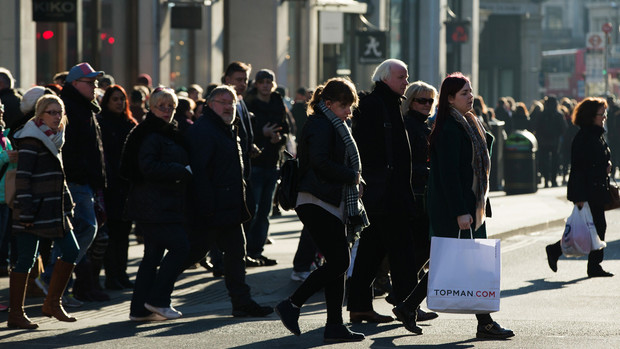
Households ramped up spending in stores at the fastest pace in more than a decade in the fourth quarter, and data Tuesday will show how much that checked the impact of weak external demand. Economists forecast growth of 0.6 percent in the three months, down from 0.7 percent in the third quarter.
While the buildup to the general election in less than four months may weigh on confidence, further stimulus may reverse the cooling trend. The European Central Bank will pump $1.3 trillion into the economy of Britain’s biggest trading partner, while a slump in oil prices and strengthening wage growth are handing Britons the spending power they’ve been missing for years.
“Growth is pulling back but the recovery hasn’t stumbled,” said Victoria Clarke, an economist at Investec Securities in London. “We’re expecting an improvement in Europe and oil might mean a big boost to consumer spending, with more to come from what we’ve already seen.”
Forecasts for the fourth quarter in the Bloomberg survey range from 0.5 percent to 0.8 percent growth. For the full year, gross domestic product probably rose 2.6 percent, according to a separate poll.
The Office for National Statistics will publish the estimate for the quarter, which is based on about 44 percent of the data that will become available, at 9:30 a.m. tomorrow. Three days later, the Bank of England will publish figures on mortgage lending and consumer credit for December.
Survey Weakness
Recent reports have pointed to softer U.K. growth, with services expanding the least in 19 months in December. Markit said this month its industry surveys indicate GDP rose 0.5 percent in the fourth quarter.
Easing the sting is a slowdown in inflation to just 0.5 percent in December, matching a record low. BOE officials have said the rate may drop to zero and there’s a chance of price declines.
The outlook prompted policy makers Martin Weale and Ian McCafferty, who’d been voting for rate increases since August, to end their push this month. Economists at banks including BNP Paribas SA and RBC Capital Markets have responded by changing their calls for the first rate increase from the current record- low 0.5 percent.
The inflation outlook signals “an extended period of caution on the commencement of the tightening cycle,” said Sam Hill at RBC, who pushed back his forecast to November from June. He raised his 2015 growth outlook, citing a “boost to consumer spending as households find that they can maintain their historic real terms of fuel consumption with money to spare.”
Spending Squeeze
With employment rising, wage gains accelerating and inflation slowing, the spending squeeze that’s plagued Britons for six years may be ending.
In its Consumer Tracker published Monday, Deloitte said discretionary spending is at a three-year high. That’s because consumers will spend “significantly less” on essentials such as food and transport as prices fall. Wage growth may average 2.9 percent in 2015, Deloitte said, citing a survey of company finance directors.
Recent evidence of a wage pickup is “not lost” on BOE officials, Governor Mark Carney said at the World Economic Forum in Davos on Saturday.
Consumer Fillip
The fillip for consumers is coming at a good time for Prime Minister David Cameron, whose Conservative Party is struggling to gain a lead in election polls before the May 7 ballot.
And there’s also stimulus in store in the euro area after ECB President Mario Draghi unveiled an unprecedented stimulus plan last week to save the region from a deflationary spiral.
Draghi’s move and the oil-price drop mean that 2015 growth could outpace last year’s, and revive the possibility of policy tightening this year. BOE official Kristin Forbes said that of the risks facing the U.K. economy, she places a higher probability on inflation slowing more in the next few quarters and then accelerating more quickly than forecast in November.
“While these drags on inflation will lower the starting point from which inflation increases, and initially slow the rate at which prices increase, they should not derail the combination of other forces that are supporting growth, core inflation, and a normalization of monetary policy,” she said in the text of a Jan. 22 speech published today by the central bank.
“For the U.K., the best thing the ECB could have done is exactly what they did,” said Rob Wood, an economist at Berenberg Bank in London and a former BOE official. “A stronger euro-zone economy should feed through to the U.K. and make rate hikes a more reasonable proposition.”
Here we are to serve you with news right now. It does not cost much, but worth your attention.
Choose to support open, independent, quality journalism and subscribe on a monthly basis.
By subscribing to our online newspaper, you can have full digital access to all news, analysis, and much more.
You can also follow AzerNEWS on Twitter @AzerNewsAz or Facebook @AzerNewsNewspaper
Thank you!