
BP faces maximum $13.7 billion fine after spill-size ruling
By Bloomberg
BP Plc faces a maximum fine of $13.7 billion after a U.S. judge ruled that the company dumped 3.2 million barrels of oil into the Gulf of Mexico in 2010 -- about a quarter less than the U.S. had calculated.
The government’s 4.2 million barrel estimate of the spill size was rejected today by U.S. District Judge Carl Barbier, decreasing the potential maximum fine from $18 billion. BP estimated the flow at 2.45 million barrels. The maximum possible fine would still be the largest U.S. pollution penalty.
Barbier, who conducted a trial without a jury over who was to blame for the disaster, previously found BP’s exploration unit had acted with gross negligence in causing the largest offshore oil spill in U.S. history. That decision triggered BP’s exposure to the maximum fines under the Clean Water Act.
Today’s ruling on the spill’s size sets the stage for a trial next week in New Orleans at which Barbier will determine the amount of the fines, based on the law’s provision for as much as $4,300 per barrel released and factors such as what BP did to minimize or mitigate the effects of the disaster.
BP still faces multiple claims by private parties and state governments. The company reached an estimated $9.7 billion settlement of claims from most private parties who alleged they were harmed by the spill. The company didn’t settle with banks, casinos, local governments and businesses claiming harm from the deep-water drilling moratorium set off by the spill. Louisiana, Alabama and other Gulf states are also seeking unspecified damages for harm to natural resources.
BP shares rose as much as 2.6 percent to 402.75 pence and traded at 401 pence as of 8:21 a.m. in London, valuing the company at 73.1 billion pounds ($111 billion).
BP Victory
“Today’s ruling is a major victory for BP and reduces by billions their potential liability,” said David Uhlmann, a law professor at the University of Michigan and former head of the Justice Department’s environmental crimes division.
“A fine in excess of $10 billion remains possible but is now less likely,” Uhlmann said in an e-mail.
The London-based oil company has set aside $3.5 billion to cover the pollution fines. BP has already spent more than $28 billion in spill response, cleanup and claims. It also reached a $4.5 billion settlement of criminal allegations in 2012.
The company had taken a $43 billion charge to cover all the costs, according to an Oct. 28 earnings statement. The ultimate cost is “subject to significant uncertainty,” BP said.
The company doesn’t expect Barbier to impose the maximum Clean Water Act fine, Geoff Morrell, a BP spokesman, said today in an e-mailed statement.
Mitigating Factors
Barbier has to consider multiple factors including BP’s efforts to minimize or mitigate the spill, Morrell said. “BP believes that considering all the statutory penalty factors together weighs in favor of a penalty at the lower end of the statutory range,” he said.
Wyn Hornbuckle, a Justice Department spokesman, said the agency was reviewing the ruling.
Anadarko Petroleum Corp., which owned a 25 percent share of the doomed well, will also be a defendant in the penalty phase of the trial. Barbier previously ruled Anadarko wasn’t responsible for the spill and is on the hook for pollution fines as a part owner of the well. The U.S. said last month it was seeking no more than $1 billion from Anadarko, which is based in The Woodlands, Texas.
“Today’s ruling regarding the volume does not change the court’s previous findings that we had no direct operational involvement in this event,” John Christiansen, an Anadarko spokesman, said in an e-mail.
Favorable Finding
BP didn’t extend the 2010 Gulf of Mexico oil spill by lying about its size or misrepresenting the efforts to contain it, Barbier also found today.
“BP was not grossly negligent, reckless, willful or wanton in its source control planning and preparation,” Barbier said.
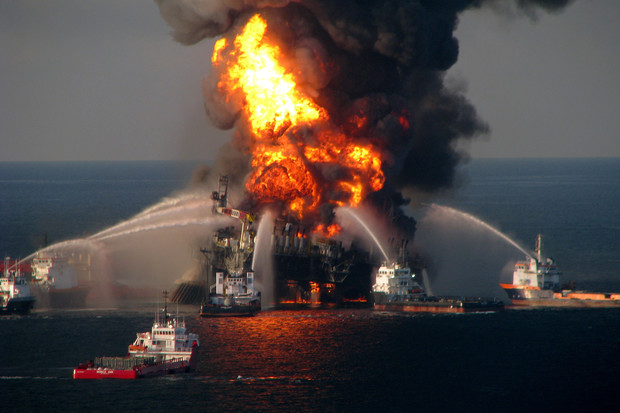
The blowout of the Macondo well off the coast of Louisiana in April 2010 killed 11 people aboard the Deepwater Horizon drilling rig and spewed oil for almost three months into waters that touch the shores of five states.
The accident sparked thousands of lawsuits against BP, as well as Vernier, Switzerland-based Transocean Ltd., the owner of the rig that burned and sank, and Houston-based Halliburton Co., which provided cementing services for the project.
Transocean’s $1 billion settlement with the U.S. in 2013 is the largest civil penalty for Clean Water Act violations, according to the Environmental Protection Agency.
Barbier conducted two trial phases in 2013, one on fault and gross negligence, the other on the size of the spill and the efforts to contain it.
Well Unstable
Lawyers for the U.S. and oil-spill victims contended in the first phase that BP was over budget and behind schedule, prompting it to cut corners and ignore safety tests showing the well was unstable.
They also alleged that Halliburton’s cement job was defective and that Transocean employees made a series of missteps on the rig, including disabling safety systems and failing to adequately train its crew and maintain the installation.
During the trial, BP also accused Transocean of failing to maintain the drilling rig and Halliburton of providing defective cementing services. Transocean and Halliburton pointed fingers back at BP.
Barbier on Sept. 4 found that BP’s exploration unit was “reckless,” while Transocean and Halliburton were merely negligent. He apportioned fault at 67 percent for BP, 30 percent for Transocean and 3 percent for Halliburton.
BP Exploration & Production is “subject to enhanced penalties under the Clean Water Act” because the discharge of oil was the result of its gross negligence and willful misconduct, Barbier held Sept. 4.
BP has appealed that decision to the U.S. Court of Appeals in New Orleans.
Spill Calculation
In the second phase of the trial, which ended in October 2013, the U.S. government contended BP’s well spewed 4.2 million barrels of oil into the Gulf before it was capped almost three months later. BP estimated the flow at 2.45 million barrels. Both agreed that their numbers would have been higher if 810,000 barrels hadn’t been captured by a siphoning device at the wellhead.
Barbier said today that 4 million barrels of oil spewed from the well and he subtracted the barrels captured at the wellhead from that amount. That left 3.19 million barrels that will be considered in determining the civil penalty, he said.
In the penalty phase, Barbier will consider eight criteria in setting the fine, including the seriousness of the violation, the degree of culpability, any history of prior violations, any other penalties for the same incident, and what BP has done to minimize or mitigate the effects of the spill.
Maximum Penalty
Under the law, Barbier also has to consider the possible economic impact of any penalty on the company. The maximum penalty under the Clean Water Act when a court finds gross negligence is $4,300 per barrel.
The U.S. said in court papers last month that it was seeking $16 billion to $18 billion in fines, based on its estimate of the size of the spill.
The case is In re Oil Spill by the Oil Rig Deepwater Horizon in the Gulf of Mexico on April 20, 2010, MDL-2179, U.S. District Court, Eastern District of Louisiana (New Orleans).
Here we are to serve you with news right now. It does not cost much, but worth your attention.
Choose to support open, independent, quality journalism and subscribe on a monthly basis.
By subscribing to our online newspaper, you can have full digital access to all news, analysis, and much more.
You can also follow AzerNEWS on Twitter @AzerNewsAz or Facebook @AzerNewsNewspaper
Thank you!