
NASA probe’s 3 billion-mile trip to end in dwarf planet’s orbit
By Bloomberg
A NASA spaceship, its engines too weak to power a skateboard, is drawing closer to a never-visited dwarf planet in a quest to learn more about how Earth was formed.
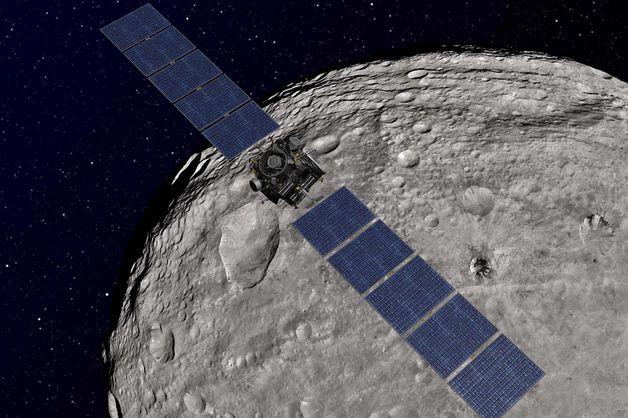
Dawn, a golf-cart-size NASA probe launched seven years ago, is on its way to rendezvous with Ceres, a minor planet as big across as Texas, on March 6. A rocky globe that probably holds a reservoir of ice, Ceres may provide keys to understanding what our own planet was like at the very beginning of its formation.
Once Dawn reaches Ceres, it will be the first spacecraft to visit two celestial bodies on a single voyage, with a mission to study the formation of the solar system. Until 2012, Dawn had been circling Vesta, an asteroid whose core resembles our planet’s and whose surface was so shattered by impacts that the resulting meteorites have found their way to our planet.
“Both Vesta and Ceres are like building blocks of planets,” Marc Rayman, the mission’s chief engineer, said in a phone interview. “Studying them may give us insight into the conditions and process that occurred when planets were forming.”
More than 4.5 billion years ago, the sun was surrounded by a massive dust cloud that gradually clumped together to create the planets. Jupiter grew so massive that its gravity cut off that process in its neighborhood, leaving the two giants in the asteroid belt, Ceres and Vesta, far smaller than the planets.
While scientists used to consider the solar system to have nine planets, astronomers demoted Pluto in 2006, putting it in a new dwarf planet category, where it’s now joined by Ceres and three others, according to the International Astronomical Union.
Perpetual Orbit
Ceres was the first minor planet discovered, having been sighted on New Year’s Day in 1801, 129 years before Pluto. A sphere that may hold more fresh water than Earth, it’s also the largest object between the sun and Pluto not yet visited by a spacecraft. After surveying the dwarf planet, Dawn will end its mission at Ceres.
“It will stay in orbit just as surely as the earth stays in orbit around the sun, or the moon around the Earth,” Rayman said.
NASA calls Dawn the “Prius of space,” thanks to its three weak, super-efficient engines, something akin to the power plant in the Toyota Prius hybrid.
Its ion engines work by running an electrical current, fed by solar panels, through xenon gas, the same element used in camera flashbulbs and car headlights. The xenon ions generated by the basketball-size engines create a low, persistent thrust, enough to power Dawn’s journey of 3 billion miles (4.8 billion kilometers) to Ceres.
Here we are to serve you with news right now. It does not cost much, but worth your attention.
Choose to support open, independent, quality journalism and subscribe on a monthly basis.
By subscribing to our online newspaper, you can have full digital access to all news, analysis, and much more.
You can also follow AzerNEWS on Twitter @AzerNewsAz or Facebook @AzerNewsNewspaper
Thank you!