
Yen falls for second day as stocks, oil gain; Aussie strengthens
By Bloomberg
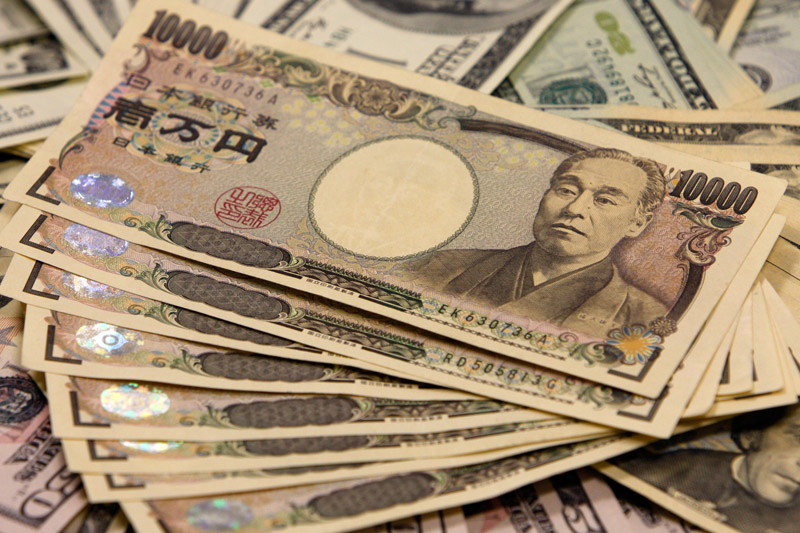
The yen fell for a second day against the dollar as stocks rose around the world before U.S. reports this week that economists said will show an improving labor market.
Japan’s currency weakened versus all of its 16 major counterparts as a rally in oil reduced demand for havens. The dollar gained for a fifth day against the euro amid speculation the Federal Reserve is moving toward raising interest rates. Europe’s common currency weakened as German factory orders fell more than economists predicted in November. Australia’s currency rose after building approvals unexpectedly increased in November. Malaysia’s ringgit ended a four-day slump.
“The decline in oil has stopped and stocks are being bought back along with the dollar as risk aversion dissipates,” said Akira Moroga, manager of currency products at Aozora Bank Ltd. in Tokyo. “The dollar could recover to 120 yen if market sentiment stays positive.”
The yen depreciated 0.5 percent to 119.83 per dollar at 8:40 a.m. London time after sliding 0.7 percent yesterday. Japan’s currency weakened 0.3 percent to 141.55 per euro. The dollar gained 0.2 percent to $1.1812 per euro after advancing to $1.1802 yesterday, the strongest level since January 2006.
The MSCI Asia Pacific Index of shares jumped 1.2 percent after the Standard & Poor’s 500 Index rose 1.2 percent yesterday. Crude oil has rallied more than 4 percent to $48.86 a barrel since falling to $46.83 yesterday, the lowest since April 2009.
Dollar Index
“We have a dollar-yen forecast of 132 by the end of this year,” Sue Trinh, senior currency strategist at Royal Bank of Canada in Hong Kong, said in a Bloomberg Television interview. “Layers of yen weakness” include the movement of assets held by the Government Pension Investment Fund into overseas holdings away from Japanese bonds, she said.
The Bloomberg Dollar Spot Index, which tracks the U.S. currency against 10 major peers, climbed 0.1 percent to 1,147.12, set for the highest close in data going back to 2004.
Initial claims for U.S. jobless benefits fell to 290,000 last week, from 298,000 the previous week, according to a Bloomberg News survey before today’s report. Employers added 240,000 workers in December, after hiring 321,000 in November, a separate survey showed before the figure is released tomorrow.
“Over 2015 and through 2016, we have an investment strategy of being broadly long of U.S. dollars,” RBC’s Trinh said, referring to a bet the currency will gain. “That will get more legs, especially as the first Federal Reserve rate hike comes onto the radar.”
Euro Slump
There’s a 59 percent likelihood the U.S. will raise its target federal funds rate from a zero-to-0.25 percent range to at least 0.5 percent by September, futures data compiled by Bloomberg show.
Europe’s common currency slid against the dollar, set for the longest stretch of declines since May, as data from Germany, which narrowly avoided a recession in the middle of 2014, added to evidence of Europe’s economic slump and strengthened the case for more stimulus from the region’s central bank. European Central Bank policy makers next decide on interest rates on Jan. 22.
Factory orders in Europe’s largest economy, adjusted for seasonal swings and inflation, slid 2.4 percent after a revised increase of 2.9 percent in October, the Economy Ministry in Berlin said today. Analysts predicted a decline of 0.8 percent, according to the median estimate in a Bloomberg News survey. Orders fell 0.4 percent from a year earlier, compared with a median forecast of a 1 percent increase.
Aussie Gains
Australia’s dollar rose against all its 16 major peers as the Bureau of Statistics said building approvals climbed 7.5 percent in November. Economists surveyed by Bloomberg predicted a decrease of 3 percent.
The Aussie gained 0.4 percent to 81.14 U.S. cents after tumbling to 80.33 cents yesterday, the lowest since July 2009.
The ringgit halted a four-day, 2.4 percent slump as the rally in crude boosted the prospects for the oil exporting country. The currency was also supported after a report yesterday showed the trade surplus climbed to the highest in three years.
“The specific catalyst in terms of why the ringgit’s a little bit stronger is that the trade balance came out a little bit better than expected,” said Mirza Baig, head of foreign- exchange and interest-rate strategy at BNP Paribas in Singapore.
The ringgit strengthened 0.4 percent to 3.5675 per dollar after sliding to 3.5862 yesterday, the weakest since July 2009.
Here we are to serve you with news right now. It does not cost much, but worth your attention.
Choose to support open, independent, quality journalism and subscribe on a monthly basis.
By subscribing to our online newspaper, you can have full digital access to all news, analysis, and much more.
You can also follow AzerNEWS on Twitter @AzerNewsAz or Facebook @AzerNewsNewspaper
Thank you!