
What bad-loan crisis? China bank stocks jump most since 2009
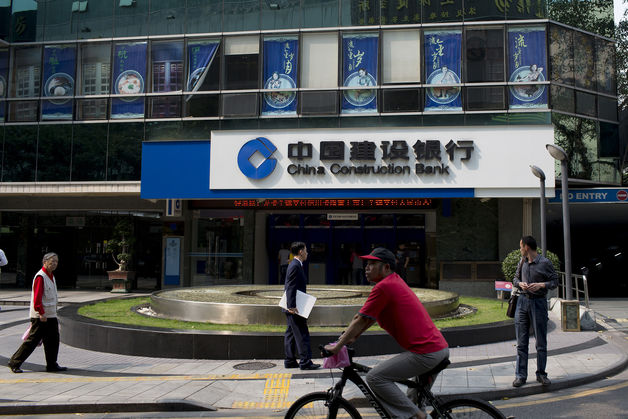
By Bloomberg
China’s bank shares are on track to end their best year since 2009 as investors brush aside an economic slowdown and bad-loan risks.
Industrial & Commercial Bank of China Ltd. and 15 peers have rallied an average of 48 percent this year in China, after losing about one-third over the previous four years. Chinese banks listed in Hong Kong have gained 13 percent.
“The stocks were just too cheap, especially in a global context,” said Sandy Mehta, chief executive officer of Hong Kong-based Value Investment Principals Ltd. “Valuations are still very attractive, and many investors feel the overall economy is also bottoming out and reviving with the recent government stimulus.” He wouldn’t disclose holdings.
Chinese banks remain the cheapest in the world at 6.2 times estimated earnings, the lowest for lenders with a market value of more than $10 billion, data compiled by Bloomberg show. In 2009, China’s bad loans were falling and the economy grew 9.2 percent. Analysts surveyed by Bloomberg expect this year’s expansion to be 7.4 percent, the smallest since 1990.
The surge in China’s banks this year has outstripped the 4.1 percent gain in the KBW Bank Index made up of 24 U.S. bank stocks and the 6.4 percent decline in the 45-member Bloomberg Europe Banks and Financial Services Index.
‘Amazing’ Change
“It’s amazing to see investors, who seemed to have given up on bank stocks back in 2010, turning positive at this point,” said Jim Antos, a Hong Kong-based analyst at Mizuho Securities Asia Ltd.
The nation’s build-up of debt from record borrowing has prompted analysts to draw comparisons with Japan before its “lost decade” of economic stagnation and with Asian nations tipped into crisis in the late 1990s. China also faces risks from government efforts to boost the role of markets in the economy, including by fueling banks’ competition for deposits.
For now, investors may be more focused on officials’ efforts to support growth, with the central bank last month cutting interest rates for the first time in two years. A gauge of financial shares climbed to a six-year high yesterday. The Shanghai Composite Index was at a four-year high.
Restructuring of state-owned enterprises such as China Citic Bank Corp. and China Everbright Bank Co., plans for bank employee stock incentives and an easing of mortgage restrictions for borrowers in September are positive for lenders, according to Antos and analysts at China International Capital Corp.
Monetary Outlook
In addition, investors are speculating that the central bank will cut the amount of deposits that lenders must set aside as reserves, while the government may ease bank loan-to-deposit ratios, another constraint on lending.
“Investors don’t want to be left out,” said Elke Schoeppl-Jost, Asia-Pacific chief investment officer for Deutsche Asset & Wealth Management, which globally oversees about 1 trillion euros ($1.2 trillion). “The beginning of the China easing cycle coupled with market rumors of reserve-ratio requirement cuts and possible bank liquidity injections prior to the Chinese New Year will keep bank equities well bid,” said Schoeppl-Jost, who’s based in Hong Kong. She wouldn’t discuss specific holdings.
Profit growth at China’s biggest banks this year will be 7.5 percent, the lowest in more than a decade, according to analysts’ estimates. Bad loans have climbed 30 percent this year to the highest level since 2008, according to the government.
Deposit Rates
The central bank last month raised a ceiling on deposit rates, intensifying competition between lenders. It also announced plans for deposit insurance, which would be a move toward scrapping interest-rate controls and allowing lenders to fail in a more market-driven economy.
Banks listed on the mainland are trading at about 1.2 times estimated book value. Rainy Yuan, an analyst at Masterlink Securities Corp. in Shanghai, said that may be the ceiling in what she describes as “an insane bull run.”
The Shanghai Composite Index climbed 25 percent in four weeks, partly fueled by expanded margin trading. ICBC fell 2.7 percent in Shanghai today to close at 4.35 yuan while China Construction Bank Corp. declined 3 percent.
Investors encouraged by monetary easing may be missing the point that “the economy is in pretty lousy shape,” Antos said. “What we have in the past month is a stock market bubble.”
Here we are to serve you with news right now. It does not cost much, but worth your attention.
Choose to support open, independent, quality journalism and subscribe on a monthly basis.
By subscribing to our online newspaper, you can have full digital access to all news, analysis, and much more.
You can also follow AzerNEWS on Twitter @AzerNewsAz or Facebook @AzerNewsNewspaper
Thank you!