
Ruble touches record low as interest-rate rise seen inadequate
By Bloomberg
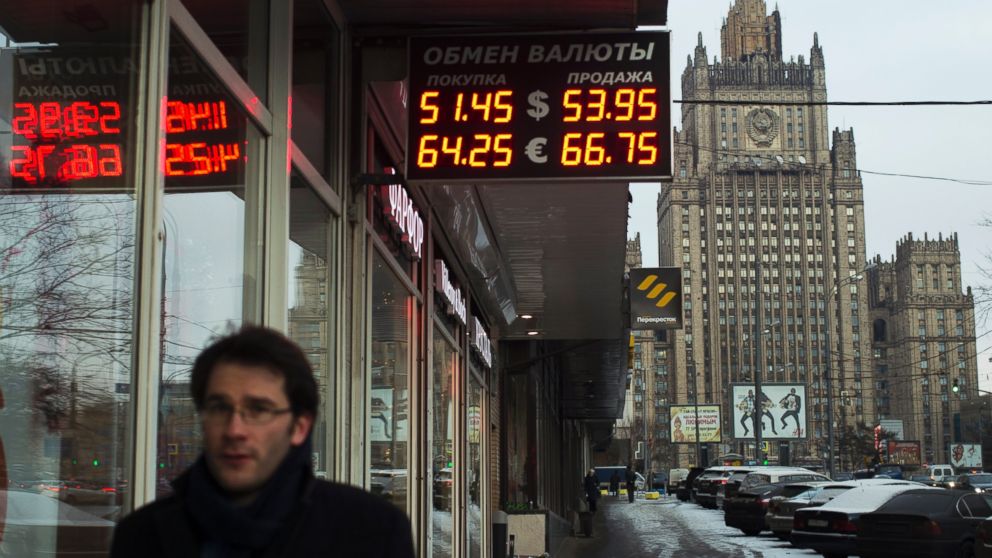
The ruble touched a record low and government debt rallied as investors bet the size of today’s interest-rate increase is a sign that the central bank remains wary of exacerbating Russia’s worst bond rout since 2009.
The ruble lost as much as 1.1 percent to 55.4550 per dollar before trading 0.3 percent lower at 3:12 p.m. in Moscow. Government bonds, known as OFZs, extended gains after the decision, pushing 10-year yields down 41 basis points to 12.21 percent. The Micex Index of equities slid 1 percent, while the dollar-denominated RTS Index dropped 1.2 percent.
Investors were counting on higher rates to stabilize the ruble after currency interventions and restrictions on ruble liquidity failed to halt the biggest depreciation in emerging markets this year. The central bank raised its key rate to 10.5 percent, matching the median estimate in a Bloomberg survey of 34 economists, yet less than predicted by most traders in a separate poll.
“This is good for the bond market, but it won’t stop the ruble selloff,” Dmitry Postolenko, a money manager at Kapital Asset Management LLC in Moscow, said by e-mail. “It would have been dangerous to increase rates by 150 to 300 basis points as that would’ve caused a strong selloff in ruble assets.”
Fifty out of 77 traders polled by Tradition forecast a rate increase of between 100 and 400 basis points, the brokerage said this week. The central bank announced its decision at 1:30 p.m. local time and will hold a press briefing later in the day.
Bond Rout
The prospect for a more-aggressive increase in borrowing costs triggered a 7 percent rout in local bonds this month, the most since February 2009, according to Bank of America Merrill Lynch indexes.
Central bank Governor Elvira Nabiullina has raised rates by 500 basis points since President Vladimir Putin’s incursion into Crimea in March. Russia’s annexation of the Black Sea region and alleged support for Ukrainian separatists in the following months triggered U.S. and European Union sanctions and prompted the biggest outflows from Russian assets since 2008.
Policy makers are facing dwindling options to stabilize the ruble as oil’s slide forced them to shift to a free-floating exchange rate last month after burning through almost $80 billion of reserves this year defending the currency.
While potentially lending some support to the ruble, the rate increase may further choke lending in an economy already facing its first contraction since 2009 next year, according to government forecasts.
Market Expectations
“Price action in dollar-ruble clearly shows the markets were counting with a much more aggressive hike,” Luis Costa, a strategist at Citigroup Inc. in London, said by e-mail. “Ultimately the central bank is being pushed into a policy of much higher money-market rates, and that might stay in the medium-term, which makes the environment very difficult for local government bonds to perform.”
The central bank was freed up to make interventions of unlimited size after it abandoned its previous rules-based system last month and let the currency float.
The ruble sank this year as oil’s slump into a bear market cut foreign-exchange revenue in the world’s biggest energy exporter. Brent crude dropped 44 percent this year and touched a five-year low of $63.56 a barrel yesterday.
‘Deja Vu’
Russian companies lost tens of billions of rubles on foreign-exchange derivatives after the central bank last month brought forward a 2015 plan to float the ruble, Interfax reported yesterday, citing Sergey Moiseev, the head of financial stability at the central bank.
The move helped push three-month implied volatility on the ruble against the dollar up by 17 percentage points since the end of October to 35 percent today. That’s the highest since at least 2005 and the most among all the currencies tracked by Bloomberg.
“It’s a deja vu all over again from last month,” Per Hammarlund, the chief emerging-markets strategist at Skandinaviska Enskilda Banken AB, said by e-mail. “They should have hiked by 200 basis points.”
Here we are to serve you with news right now. It does not cost much, but worth your attention.
Choose to support open, independent, quality journalism and subscribe on a monthly basis.
By subscribing to our online newspaper, you can have full digital access to all news, analysis, and much more.
You can also follow AzerNEWS on Twitter @AzerNewsAz or Facebook @AzerNewsNewspaper
Thank you!