
Ruble’s 38% drop helps metal and mining companies skirt selloff
By Bloomberg
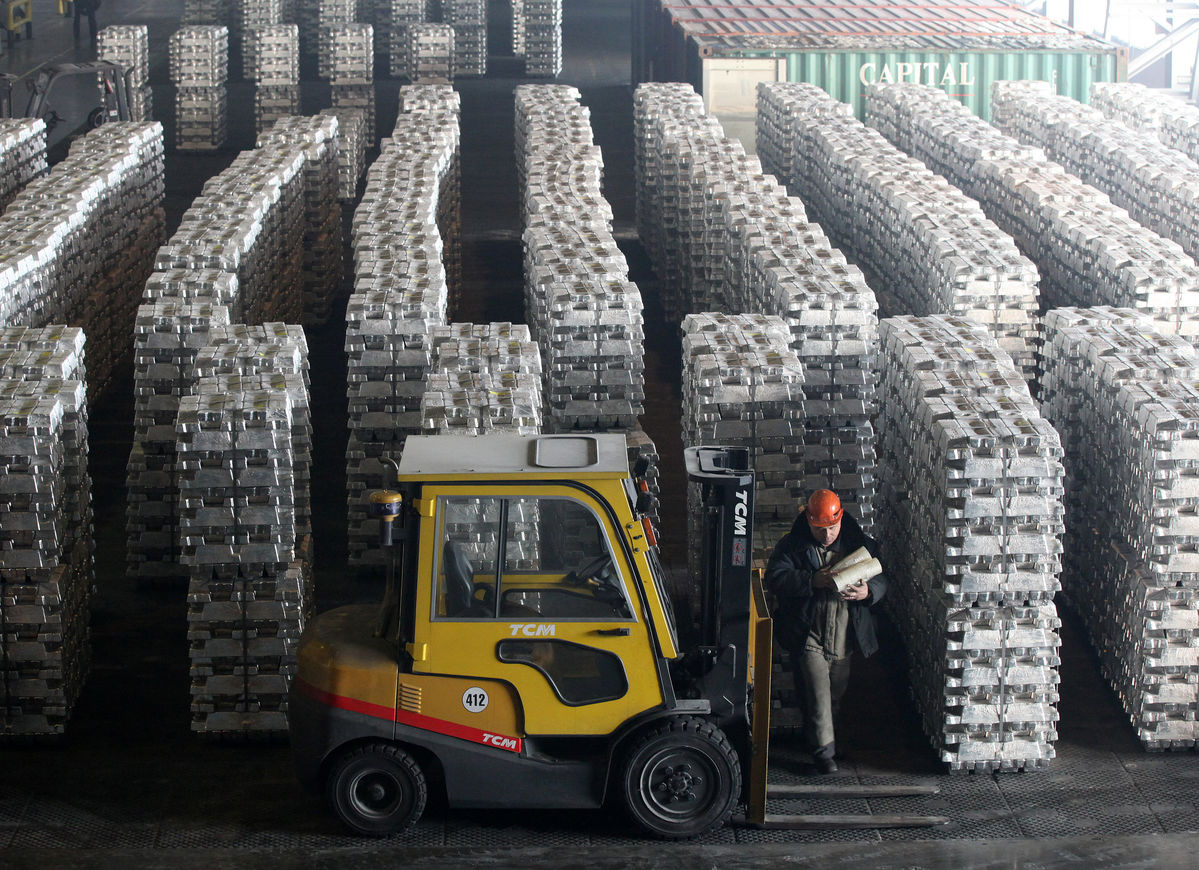
Russian metal and mining companies are winning back investors’ favor this year, avoiding a broader selloff in equities as the weakening ruble helps boost their profits from exports.
Eight of the 10 best performers in the RTS Index in 2014 are producers of raw materials from steel and nickel to diamonds and soil nutrients. While the dollar-denominated gauge sank 37 percent, United Co. Rusal, the world’s largest aluminum company that touched a record low in November 2013, led the rally in non-oil commodity stocks with an almost fourfold advance.
While stocks from lenders to utilities and airlines have tumbled as Russia’s economy headed for the first recession since 2009, the slumping ruble has lifted metal and mining companies that have costs in the local currency and make sales abroad. Crude, the country’s top export, has sunk into a bear market, driving a 38 percent decline in the ruble and exacerbating the impact that international sanctions linked to the Ukraine conflict have had on gross domestic product growth.
“The stocks of metal and mining companies are turning from ‘l’enfant terrible’ into the best performers,” Alexander Losev, the chief executive officer of Sputnik Asset Management in Moscow, said by e-mail on Dec 4. “Serious ruble devaluation is benefiting metal producers since their costs are in rubles and revenue from exports is in dollars.”
A recovery in major metal prices including aluminum and nickel also has boosted the stocks. The weighting of metal and mining companies in the benchmark Micex Index rose to 13.9 percent this year from 10.4 percent in 2013, almost matching the contribution of banks, the largest of which are sanctioned by the U.S. and Europe over the conflict in Ukraine.
Metal Prices
“The metal and mining companies almost doubled their earnings due to the weaker ruble,” Kirill Chuyko, BCS Financial Group’s head of equity research said by phone from Moscow. “At the same time commodities prices are advancing, or at least not falling as much as oil,” he said.
While Russian oil exporters have also benefited from the falling ruble, the plunge in prices has outweighed the cost advantage. Brent crude has dropped 38 percent in 2014. OAO Bashneft’s preferred shares have tumbled 41 percent this year, the most among oil companies on the RTS Index. OAO Rosneft is down 12 percent.
Aluminum prices have risen about 10 percent this year with European premiums that buyers pay for faster delivery almost doubling as the market outside China turned to deficit for the first time since 2008. Nickel has advanced more than 20 percent in 2014 after China cut output.
Pipe Producers
While saying commodity prices may come under pressure next year, Sberbank CIB raised its earnings projections for most of the Russian metal and mining companies it covers, according to a Dec. 2 research report. “We believe cost savings from a weak ruble and production optimization programs should smooth out the decline in earnings for steels and boost net income for base metals and fertilizer producers,” analysts including Irina Lapshina wrote.
Pipe producers such as OAO TMK, which is down 39 percent this year, are “the only losers from ruble depreciation, as ruble denominated pipe prices lag steel and scrap costs due to strong oil and gas companies’ bargaining power,” the Sberbank analysts wrote.
The price of hot rolled steel, exported from the former Soviet republics, has fallen 12 percent this year to the lowest level since June 2009. The weaker ruble still helped PAO Severstal and OAO Novolipetsk Steel to increase their third- quarter Ebitda margins to levels not seen in at least three years.
Ruble’s Plunge
“We see the potential for even higher share prices for Russian metal and mining names as the companies keep cutting costs regardless of the situation with the national currency, which may fall further,” Dmitry Kolomytsyn, London-based analyst at Morgan Stanley said by phone on Dec. 4.
The ruble’s 38 percent plunge this year was the worst performance in emerging markets. The median forecast among analysts surveyed by Bloomberg is for the currency to strengthen more than 10 percent to 47.13 in the first quarter of next year. The ruble dropped 1.5 percent to 53.2850 by 10:22 a.m. in Moscow today, while the RTS Index traded 0.1 percent lower at 907.72.
The weaker ruble and relatively strong commodity prices have helped companies attract investors such as Jim Rogers, who set up Quantum Fund with George Soros in the 1970s. Rogers in September joined the board of OAO Phosagro, a phosphate fertilizer-maker that has gained 83 percent this year, after buying some of the company’s shares.
In some cases, there have been additional drivers of share growth beyond the weaker ruble, BCS Financial Group’s Chuyko said. Severstal and OAO GMK Norilsk Nickel’s this year were boosted by large interim dividend payouts of $1.13 billion and $2.78 billion, respectively, he said.
“The metals sector is the theme of the year for investors,” Anvar Gilyazitdinov, who manages $10 million at Rye, Man & Gor in Moscow, said by phone. “The weaker ruble helps exporters, but in the case of oil producers, revenue from the falling ruble is overshadowed by the declining oil price.”
Here we are to serve you with news right now. It does not cost much, but worth your attention.
Choose to support open, independent, quality journalism and subscribe on a monthly basis.
By subscribing to our online newspaper, you can have full digital access to all news, analysis, and much more.
You can also follow AzerNEWS on Twitter @AzerNewsAz or Facebook @AzerNewsNewspaper
Thank you!