
NASA launches orion capsule in first test for Mars mission
By Bloomberg
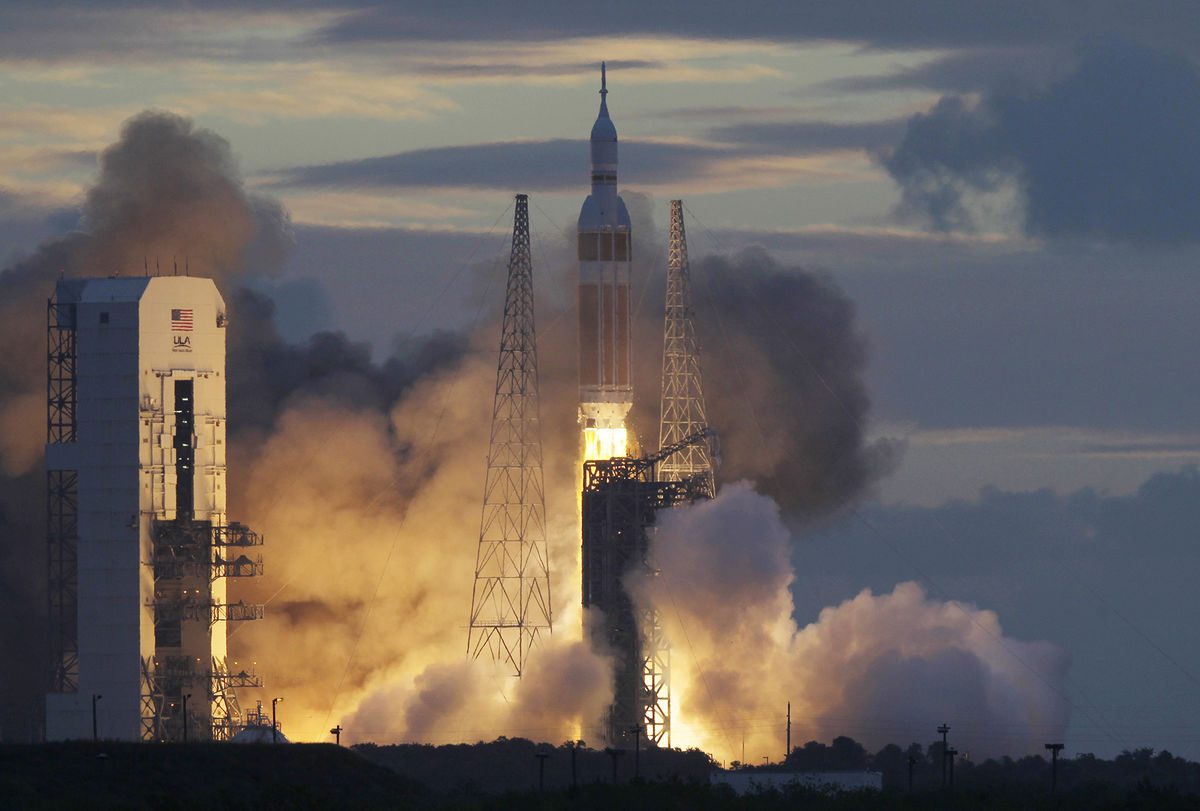
NASA successfully launched the new Orion spacecraft into orbit on its first test flight after a one-day delay, starting an unmanned venture that marks a critical initial step in the quest to carry humans to Mars.
Orion blasted off today at 7:05 a.m. from Cape Canaveral, Florida, atop a Delta IV Heavy rocket on a 4 1/2-hour excursion that will send the capsule twice around Earth before a Pacific Ocean splashdown.
“And liftoff at dawn, the dawn of Orion, and a new era of American space exploration,” the launch commentator, Steve Agid, said on NASA TV as the rocket rumbled off the pad in a pillar of flame.
Orion is NASA’s first spaceship built to carry humans beyond the moon since the 1970s, and is intended for long-range missions to asteroids next decade and to Mars in the 2030s. Built by Lockheed Martin Corp., the craft is named after one of the largest constellations in the night sky.
Today, the Delta IV rocket’s three enormous booster engines crackled, sounding like burning timber, as the spacecraft climbed off the launch pad. Hundreds of journalists, NASA employees and curious visitors watched the rocket climb above the trees east of Kennedy Space Center’s giant vehicle assembly building. Within moments it vanished into low dark clouds as its exhaust trail drifted away from the pad.
Systems Go
“It’s exciting. You have these ideas that you want to do, you pull a team together and now it’s doing the job it was designed to do,” said Mark Geyer, the Orion program manager, during the launch. “We still have a long way to go with this mission but at the beginning everything is working like it is supposed to do.”
Orion passed its first tests of new systems “flawlessly,” Geyer said, jettisoning faring panels that protected the spacecraft during liftoff and a launch-abort system designed to one day provide an escape route for astronauts.
Three hours and five minutes after liftoff, the Orion capsule is scheduled to reach an altitude of 3,600 miles (5,800 kilometers), the farthest from Earth traveled by a vehicle designed for humans since the end of the Apollo program in 1972. The National Aeronautics and Space Administration is targeting a trip with astronauts by 2021.
On its return, the spacecraft will reach speeds of 20,000 miles per hour and get as hot as 4,000 degrees Fahrenheit (2,200 degrees Celsius) before making a parachute-cushioned water landing off Mexico’s Baja peninsula.
The liftoff avoided the issues that derailed yesterday’s attempted launch, when the countdown was delayed four times by NASA officials, first due to an unauthorized boat too close to the range, twice for wind gusts and finally for a technical issue involving the boosters.
21st Century
While similar in appearance to the Apollo capsules that first flew in the 1960s, Orion was built with 21st-century manufacturing techniques and materials, Bill Hill, NASA’s deputy associate administrator for exploration systems development, said in an interview before the launch.
Orion’s Ethernet networking technology can move data 1,000 times faster than current systems on the International Space Station. The craft features dozens of innovations in its crew and service modules, as well as a launch-abort system intended to increase astronauts’ safety on future flights by rocketing the capsule clear of its boosters in the event of a malfunction at liftoff.
The capsule can hold as many as four people, one more than the Apollo vehicles a generation ago. The habitable space has been expanded to more than 300 cubic feet (8.5 cubic meters) -- a 45 percent boost in roominess over Apollo’s cabin.
Stress Tests
Today’s flight is designed to provide the most challenging tests to the craft as possible. Engineers will harvest data on the capsule’s performance in advance of manned missions and ensure that it can stand up to the radiation and other harsh conditions of space.
“We intend to stress the systems,” Geyer said at a pre- launch press briefing. “We need to make sure it works right before we put people into it.”
The latest capsule has been in development since 2006, when it was commissioned for lunar travel under the Constellation program. The Obama administration canceled the return to the moon in 2010, over budget and years behind schedule, shifting focus to Orion and trips farther into the solar system.
“This is absolutely the first step in a deep space mission that NASA is embarking on,” said Mike Hawes, Lockheed’s Orion program manager, in a Nov. 20 interview.
Trip Lessons
Lessons learned from today’s trip will be incorporated into the next Orion vehicle, Hawes said.
NASA spent about $4.7 billion on Orion’s development and design as part of the Constellation program and expects to invest another $8.5 billion to $10.3 billion in craft through 2021, the Government Accountability Office said in a May 2014 report.
The agency doesn’t yet have a rocket powerful enough to blast it into space that is also deemed safe enough to transport people. “It’s kind of like sitting in a beautiful Cadillac, without an engine or tires,” said Marco Caceres, director of space studies for Teal Group, a Fairfax, Virginia-based consultant.
The Delta IV rocket, built by the Lockheed-Boeing Co. venture United Launch Alliance, is serving as a temporary propulsion system until a next-generation rocket is developed.
Orion will be paired with the new rocket system in an unmanned test flight scheduled for 2018 that will travel 435,000 miles past the moon in an elliptical orbit.
Its next flight, slated for early next decade, will take astronauts to the same region in a 25-day test of humans’ ability to live and work independently of Earth, according to a NASA white paper published May 29.
While Mars’s distance from Earth varies because of the two planets’ orbits, the average is about 140 million miles, almost 600 times longer than the trips to the moon made by the Apollo astronauts.
To help reduce costs for more-routine, near-Earth missions, NASA is turning to private industry, including the company led by billionaire Elon Musk, for tasks such as ferrying freight and astronauts to the space station. Jeff Bezos’s Blue Origin venture is working on an advanced engine that could power the large new rockets NASA plans to develop in the 2020s.
Here we are to serve you with news right now. It does not cost much, but worth your attention.
Choose to support open, independent, quality journalism and subscribe on a monthly basis.
By subscribing to our online newspaper, you can have full digital access to all news, analysis, and much more.
You can also follow AzerNEWS on Twitter @AzerNewsAz or Facebook @AzerNewsNewspaper
Thank you!