
Imagining the Dividends of Peace
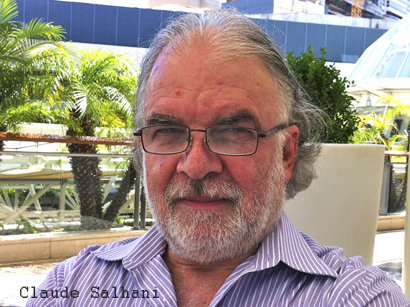
By Claude Salhani
Senior editor of the English service of Trend Agency
Summary: As bombs continue to fall on Gaza it may be somewhat
premature to talk about peace in the Middle East but it is never
too early to dream of peace. Imagine a Middle East without war and
imagine what the people of the region could achieve if conflict was
not omnipresent.
Imagine if billions upon billions of dollars currently being wasted
on defense budgets in the combined countries of the region was
invested instead in the advancement of social welfare, in
encouraging businesses, and stimulating the sciences.
Consider the leaps and bounds that could be made in research and
development in technology and medicine if the best brains in the
Middle East could work for the benefit of the people of the region
instead of looking for ways to emigrate to America and other
greener pastures, as is currently the case affecting faculty
members from the universities at Ain Shams to Yarmouk and from
Beirut to Tel Aviv.
Imagine the rise in intellectual power if students in the Middle
East could exchange ideas rather than insults, debate in lieu of
hate, and scholarly theses in place of explosive devices. How would
the level of education and understanding improve if scholars could
lecture across the region without being prevented by man-made
frontiers, both physical and mental?
These are just a few basic ideas in a sea of endless possibilities,
where the only barriers are those erected by demagoguery and
backward thinking. Of which, alas, the Middle East abounds.
Still, imagine the Middle East with a flourishing tourism trade
where visitors bringing hard currency by the bucketful arrive on
pilgrimages to the Holy Land without fear of bombs exploding in
roadside cafes.
Imagine a Middle East where border disputes are a thing of the
past. Hard to imagine? Look at Europe; how many wars were fought
between France and Germany? Between France and England? Between
Germany and Russia? Between the Austrian-Hungarians and their
neighbors? How many armies waltzed across Poland and how many times
were the borders shifted, re-drawn and shifted back?
Look at Europe today. Twenty-seven nations speaking 28 different
languages as diverse as French, Lithuanian, Hungarian and Maltese,
practicing dozens of different religions, but united in the single
largest economic market in the world. War in Europe today is
unimaginable because the EU has intertwined the economies of its
member states in such a manner that it is simply unthinkable for
any two members to resort to armed conflict any longer. How
difficult could it be for the Middle East where there are only two
languages and far fewer religions?
So imagine a similar political climate enveloping the Middle
East where tourists arrive by cruise liner to Beirut or Haifa, or
by charter flights to Baghdad, Tehran or Ben Gurionairports and are
free to roam throughout the region without worry of fundamentalist
abduction or of Israeli threats of retaliation on a massive scale,
as is going on in Gaza today. Visualize how business and as a
result the standard of living would benefit if people and
merchandise could be driven from Lebanon to Israel, to Gaza and on
to Egypt.
Think of what the tourism industry could offer with its temperate
climates most of the year. When Europe is freezing in the dead of
winter, and depression and suicide rates climb to their highest
point in northern Europe, when the sun is visible for just a few
hours a day, if that, the beaches of Beirut, Tel Aviv and Gaza only
a couple of hours by plane from any European country can be very
enticing - and economically sound.
Imagine a vast industrial zone established in Gaza where labor is
abundant, easy to train, and inexpensive; and where European and US
car manufacturers can open assembly plants and textile mills to
market their products in the Middle East and Africa and beyond.
Imagine Christian pilgrims looking to follow in the footsteps of
the great prophets, travelling unhindered from Israel to Palestine
to Jordan to Syria and to Lebanon. Imagine Muslim pilgrims doing
the same from Makkah and Medina to Karbala, Jerusalem and Qom.
Imagine Syrian Jews being allowed to return to visit Damascus.
Imagine a Middle East without refugees! Where the camps of shame -
now 66 years in existence, and where second - and now
third-generation refugees are still squatting amid rancor and
misery - no longer exist.
Imagine those camps replaced by decent, modern and comfortable
apartment buildings with all the amenities of modern life; where
the idle youth who were once only too happy to be offered an AK-47,
a monthly stipend consisting of a few hundred dollars, along with
unlimited prestige that accompanied the uniform of a "freedom
fighter," and nothing else, let alone hope for a better future, can
now aspire to a better life for themselves and their families. Give
them a taste of what life should be like, then take a head count to
see how many remain in line for suicide missions.
Amid the death and destruction what would it take to for neighbors
to be, well, neighborly? The answer is somewhat simple: the day the
antagonists in the Middle East will agree on peace is when they
develop greater love for their children that the hate they harbor
for their enemies.
Claude Salhani is senior editor of Trend New Agency. Follow him at
on Twitter @ClaudeSalhani
* Note. The is an updated version of an similar article first published in 2009
Here we are to serve you with news right now. It does not cost much, but worth your attention.
Choose to support open, independent, quality journalism and subscribe on a monthly basis.
By subscribing to our online newspaper, you can have full digital access to all news, analysis, and much more.
You can also follow AzerNEWS on Twitter @AzerNewsAz or Facebook @AzerNewsNewspaper
Thank you!