
Future of Azeri-Uzbek ties: transport links and investments
By Viktoriya Zhavoronkova, Trend commentator
Azerbaijan's relations with its CIS partners, in particular, with the countries of Central Asia, have intensified recently, which is proven by state visits of the leaders of Tajikistan, Kyrgyzstan and Uzbekistan.
Uzbekistan has played and continues to play an important role in the foreign policy of Azerbaijan, which is based not only on historical and linguistic affinity of the two nations, but also on mutual political support and broad prospects for bilateral economic cooperation. Uzbekistan and Azerbaijan historically have had similar positions on major issues of regional and international politics, including the Armenia-Azerbaijan conflict over Nagorno-Karabakh, and Baku's position on the issue has been consistently and strongly supported by Tashkent.
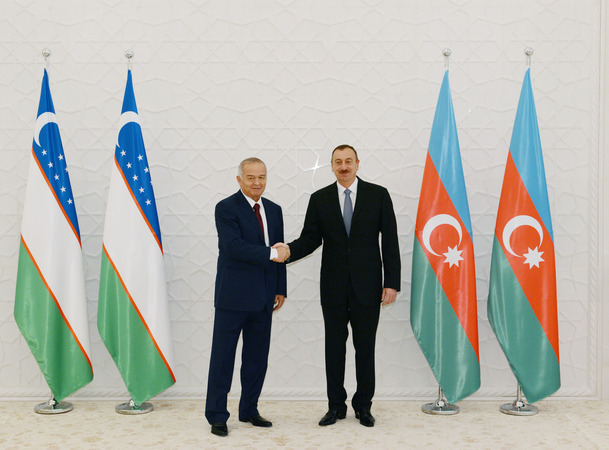
The visit of President Islam Karimov to Azerbaijan last week aimed to address the issues of multi-faceted bilateral cooperation, to give a new impetus to bilateral relations, as well as pave the way for their development in new promising areas.
We have already seen the results of the latest exchange of visits by the leaders of Azerbaijan and Uzbekistan, including those in economic cooperation.
Uzbekistan and Azerbaijan are trading partners. Uzbekistan supplies vehicles, nonferrous metals, pharmaceuticals, fertilizers, electrical and mechanical equipment, and agricultural products to Azerbaijan, as well as provides services in transport, tourism and other sectors.
Azerbaijan exports mechanical devices, pastry, various organic chemicals, and tanning extracts to the Central Asian state.
Companies with Azerbaijani capital are represented in some sectors of Uzbekistan's economy.
Azerbaijan is also an important partner of Uzbekistan in the field of transport infrastructure. Its geographical location, as well as political and economic stability make the South Caucasus republic located at the crossroads of Europe and Asia an important transit country through which Uzbekistan will be able to transport cargo to Europe and in the opposite direction.
Recently Central Asian countries have taken a particular interest in transport links to Europe via the Caspian Sea and the Caucasus to the Black and Mediterranean Seas. This interest is justified, as these routes will reduce the length of the existing transport corridors around the Caspian Sea, and diversify transportation routes in the region.
In this respect, it is worth noting the importance of Baku-Tbilisi-Kars railway, which could transport goods from Uzbekistan through Azerbaijan to Europe and the Middle East.
The Azerbaijani and Uzbek presidents paid particular attention to this issue during Karimov's visit to Azerbaijan last Thursday and Friday. The parties anticipate that this project will provide new conditions for transport and communication projects, which are economically efficient.
Baku-Tbilisi-Kars railway is important for Azerbaijan as a transit country and for the Central Asia region as a short and convenient route to Europe. It is certainly important for Tashkent, which will gain a great opportunity to further expand into new markets.
In addition, the sides touched upon the issue of creating a new route, the new Silk Road, which, as noted in a joint press statement of the Azerbaijani and Uzbek leaders, "will unite the continent for many years and provide for a large transport capacity and realization of this capacity for our countries, as well as promote confidence-building measures in the region."
During the visit the presidents of Uzbekistan and Azerbaijan also discussed the issue of investments, which was quite predictable.
Both Azerbaijan and Uzbekistan have great economic and financial potential as well as extensive technical capabilities for the development of investment cooperation.
The sides signed an action plan during Karimov's visit to Azerbaijan to implement the program on economic cooperation between the governments of Azerbaijan and Uzbekistan for 2012-2015.
The signing of this document is a reason to expect expansion of economic cooperation between the two countries, which is essential to strengthen their economies and diversify foreign economic relations.
The action plan was one of the three documents signed following a meeting of Azerbaijani President Ilham Aliyev and his Uzbek counterpart in Baku last Friday. In addition, the two presidents inked a joint declaration, while the two countries' foreign ministers signed a program of cooperation between the two countries' foreign ministries for 2013-2015.
Now it's safe to say that in case the signed agreements are successfully enforced, Karimov's visit to Azerbaijan will make a major contribution to the constructive political dialogue between Tashkent and Baku, as well as promote the development of economic and cultural relations, which will be another important element in the effective cooperation of the two friendly states.
Here we are to serve you with news right now. It does not cost much, but worth your attention.
Choose to support open, independent, quality journalism and subscribe on a monthly basis.
By subscribing to our online newspaper, you can have full digital access to all news, analysis, and much more.
You can also follow AzerNEWS on Twitter @AzerNewsAz or Facebook @AzerNewsNewspaper
Thank you!