
Oil prices stay level in the face of adversity
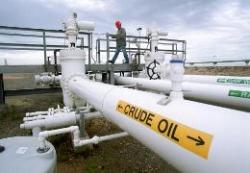
In the face of adversity it is surprising how oil prices have stayed at the level they are
(Gulf News, October 31) – In the face of adversity – the worsening European debt crisis in particular and the economic situation in the rest of the world in general – it is surprising how oil prices have stayed at the level they are.
Because of the situation in Greece and the European debt crisis, oil prices have been dropping since mid-September when the price of the Opec basket of crudes was $110.69 (Dh406) a barrel and hit its lowest level of $98.59 a barrel on October 4.
However, persistent news that a solution is forthcoming to prevent a Greek default and to shore up reserves to strengthen bank positions, allowed prices to recover to the highest level in October of $110.13 a barrel only to drop and rise in a volatile manner and end the month on about $109 a barrel after the final announcement that the EU leaders have agreed a deal to salvage Greece. The average price for October is now close to $105.53 a barrel compared to $107.61 in September.
Forecasts of economic growth by the IMF have been revised downward not only because of Eur-ope but due to some tightening in China and India to combat inflation. World growth is now projected at 3.7 per cent in 2012 "with significant downside risk", down from initial forecast of 4.1 per cent last July. Accordingly, both Opec and IEA have revised oil demand estimates downward, yet the call on Opec oil in 2012 is 29.9 million barrels a day (bpd) according to Opec and 30.5 million according to IEA.
Moderating factors
Going into the cold and higher demand season, the recovery in
prices could have been higher. But the situation is influenced by a
number of moderating factors. To start with, traders would want to
see how the deal in Europe will work as some believe that growth in
Europe will remain slow for some time to come, due to austerity
measures, though the main risk is averted for the time being.
At the same time the return of oil production in Libya is anticipated though the views vary as to the speed of such return. The wider view is that production now is about 400,000 barrels a day and that ConocoPhillips has loaded the first cargo to be delivered to French ports.
But the IEA's chief economist Fatih Birol described expectations of Libyan production as "optimistic" and added that "this could keep supply relatively tight" as "nobody has the exact appraisal of the current situation of the infrastructure." He said that he will be surprised if "Libya comes back by 2013 to pre-war levels".
However, Libyan sources recently said full output would return in 14 to 15 months. The Libyan production is not yet reflected in Opec production, which fell in September to 29.9 million bpd and even if recent numbers are added, Opec production will still be below what it was before the Libyan crisis.
Is it possible that the Iraqi scenario is being played here? The security situation is not yet clear and the return of thousands of oil employees has yet to take place on a large scale and above all a full-fledged government has yet to be formed and it is not known if it can avoid the temptation of becoming politically driven with respect to previously signed agreements. Another moderating factor is the strong rally in the US dollar fuelled by Europe's debt crisis, which pushed investors somewhat out of the commodities market.
Tightening supplies
On the other hand some factors have contributed to the price
recovery. OECD stocks have continued their recent falls to below
the five-year average, indicating tightening supplies or a better
than estimated demand. Reuters reported that "global oil demand may
be more robust than expected" according to the IEA's chief
economist who said "the decline in oil demand may not be so big,"
and "oil is needed to burn at power generators in Japan following
the tragic accident at the Fukushima nuclear plant" and "demand
from the Middle East and China is still very strong."
Volatility
Also lifting prices was a Goldman Sachs report citing tightening
supplies where "total inventories are now 31 million barrels below
their five year average." At the same time the long term view of
oil prices as taken by oil company planning is rising.
Only a decade ago, the industry based its plans on an oil price assumption of around $25 a barrel. But BP chief executive Bob Dudley recently said, "I think you'll find more and more people in the industry using numbers of $90 to $100 a barrel going forward."
Again, all will depend on the economy but the market seems to be poised for similar price levels in the months ahead with the constant feature of volatility.
Here we are to serve you with news right now. It does not cost much, but worth your attention.
Choose to support open, independent, quality journalism and subscribe on a monthly basis.
By subscribing to our online newspaper, you can have full digital access to all news, analysis, and much more.
You can also follow AzerNEWS on Twitter @AzerNewsAz or Facebook @AzerNewsNewspaper
Thank you!