
Caution sets in after BP-Rosneft deal
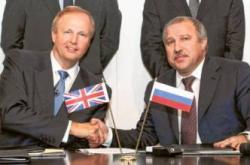
(Reuters, January 17) – Investors and analysts gave a cautious welcome on Monday to BP's share swap and Arctic exploration deal with Russia's Rosneft, saying that any return is likely a long way off.
Shares in BP traded up 1.7 percent, outperforming a 0.6 percent rise in the STOXX Europe 600 Oil and Gas index .SXEP.
BP agreed on Friday to form a joint venture with Rosneft to develop three of Rosneft's offshore exploration blocks in northern Russia, which the companies said could hold as much oil and gas as the UK North Sea, implying a 60 billion barrel prize.
Monday's share rise was a more muted reaction than the initial excitement that greeted early rumours of the deal, which led BP's New York-listed American Depositary Receipts to close up 3.6 percent on Friday.
BP faces opposition to the deal from Russian oligarchs, the defunct Yukos, whose assets make up the bulk of today's Rosneft and some U.S. politicians.
British media reported on Monday that the billionaire partners who co-own TNK-BP, Russia's third-largest oil company, with BP, were examining whether the exploration plan violates the terms of their partnership.
A BP spokesman said its partners had been "kept in the loop" about developments and that BP Chief Executive Bob Dudley had met one of the oligarchs on Thursday to discuss the deal.
Svetlana Grizan, oil analyst at VTB, said hopes that a successful challenge would prompt BP to use TNK-BP as its vehicle for the Arctic investment drove a 3.4 percent rise in a Moscow-listed TNK-BP unit.
Shareholders of YUKOS are seeking $98 billion from Russia in a European Court of Human Rights suit.
And a U.S. congressman has called for greater scrutiny of the deal, citing security concerns as BP is one of the key suppliers of the U.S. military.
Rosneft shares traded up percent 4.2 percent on hopes that BP's offshore technology will enable it to tap reserves that analysts believe it does not have the skills to access alone.
Analysts said while the deal offered the potential of big reserves additions, it did not solve all the problems facing BP, such as falling production and big cash demands, after its Gulf of Mexico oil spill - the worst in United States' history.
"While this deal is a good long-term opportunity, it does little to address the lack of short-term growth," analysts at Bernstein said in a research note.
BP has been forced to sell oil fields to pay for the spill and investors fear the company will face regulatory delays in developing its remaining fields in the U.S. - home to 40 percent of its assets.
As part of the deal, BP will swap a 5 percent stake in itself for a 9.5 percent stake in Rosneft.
Gordon Gray, analyst at Collins Stewart, said that since Rosneft paid a much lower dividend that BP did, the share issue would be dilutive to BP's earnings.
The transaction has also revived criticism surrounding assets seized from YUKOS and later bought, via a knock-down government auction, by Rosneft.
Shareholders of YUKOS are seeking $98 billion from Russia in a European Court of Human Rights suit and a spokeswoman said BP faced legal risks.
A U.S. congressman has also called for greater scrutiny of the deal, citing security concerns as BP is one of the key fuel suppliers to the U.S. military.
Dudley said BP didn't need U.S. approval for the deal.
Zeal for a deal remains
Analysts said the deal showed that BP's ability to take risks had
survived the oil spill disaster.
"One of the key dangers for BP is that, in the aftermath of the spill, it would either be nervous about doing deals, or that it would simply be blocked because of reputational issues. Neither appears to be the case," analysts at UBS said in a research note.
Australia said on Monday it had awarded BP four offshore licences in another sign that governments are not barring the oil major from offshore exploration following the oil spill.
Full financial terms of the deal have not yet been concluded but it is clear the joint venture will not own the Arctic oil blocks but merely a right to develop them.
This echoes a structure Gazprom agreed with France's Total SA and Norway's Statoil for the development of the Shtokman gas field.
Yet little progress has been made on Shtokman, which sits in the Barents Sea, since the deal was signed in February 2008, partly due to weak gas prices.
Unpopular deal structure
Oil companies traditionally dislike structures that deny them
ownership of reserves as it limits the upside from high oil and gas
prices. Nonetheless, BP's track record suggests it can make a
success of them, even where others think otherwise.
When Iraq offered eight licenses to develop oil fields under tight economic terms in 2009, BP was the only western oil major to sign a deal. The company then spent months haggling for the removal of a layer of taxation which analysts later said doubled the margins on the contract.
Under the new terms, BP's rivals returned to the bidding table and snapped up the remaining licenses.
Here we are to serve you with news right now. It does not cost much, but worth your attention.
Choose to support open, independent, quality journalism and subscribe on a monthly basis.
By subscribing to our online newspaper, you can have full digital access to all news, analysis, and much more.
You can also follow AzerNEWS on Twitter @AzerNewsAz or Facebook @AzerNewsNewspaper
Thank you!