
European states clinch Nabucco deal to curb reliance on Russian gas
The West, which is concerned over the recent
agreement on Azerbaijan's exporting gas to Russia, is accelerating
the implementation of the Nabucco pipeline project to deliver
Caspian and Middle Eastern gas to Europe. For this purpose, the
governments of the states through which the conduit will run,
bypassing Russia, signed a historic deal in Ankara on Monday in a
bid to curb Moscow's dominance on gas supplies to energy-thirsty
world markets.
The Nabucco Intergovernmental Agreement, which was signed by the prime ministers of transit countries Turkey and EU member states Bulgaria, Romania, Hungary, and Austria, represents a remarkable step toward diversifying EU energy supplies. The accord, referred to as "the Contract of the Century" in Turkey, paves the way for beginning construction of the Nabucco pipeline, opening up the opportunity for 27-member EU states to tap directly into non-European gas reserves.
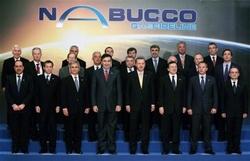
The signing ceremony was attended by officials from nearly 30 countries, including Georgian President Mikheil Saakashvili, Azerbaijani Minister of Industry and Energy Natig Aliyev, Iraqi Prime Minister Nuri Al-Maliki, US Special Envoy for Eurasian Energy, Richard Morningstar, as well as European Commission President Jose Manuel Barroso.
The 3,300-kilometer Nabucco pipeline - which will run from eastern Turkey to the Austrian capital Vienna, close to the Baumgarten gas hub - is expected to come online in 2014. When fully operational, it could carry 31 billion cubic meters of gas annually and supply between 5-10 percent of the EU's projected gas consumption in 2020. But there is still lingering uncertainty over who will supply the gas. European officials say Azerbaijan, Iraq and Egypt are considered the main suppliers for Nabucco, delivering 15 billion cubic meters of gas per year from 2015.
Turkmenistan, Kazakhstan, Uzbekistan, and Iran are considered potential suppliers for Nabucco. Turkmenistan said last week it was ready to supply Nabucco with gas, despite its earlier reluctance.
Turkish Minister of Energy and Natural Resources, Taner Yildiz, has said Russia may join the project as well.
Russia, the EU's largest supplier, currently provides around 30 percent of EU gas requirements. International attention to the project increased after Russia and Ukraine faced-off in a gas dispute early this year, and the EU is now seeking alternative sources.
Construction of the Nabucco pipeline is due to begin in 2011. According to the EU, 8 billion euros will be spent on the project. Over half of the conduit - 2,017 km - will travel through Turkey, while 392 km - through Bulgaria, 457 km through Romania, 388 km via Hungary, and 46 km through Austria.
Speaking at the signing ceremony, the Azerbaijani energy minister said Azerbaijan is interested in the Nabucco pipeline project and the gas-rich Caspian country seeks the diversification of its energy export routes. Aliyev noted that Baku supports any steps to move the implementation of the project forward.
"I am confident that the project will be successfully implemented," said the minister, adding that Azerbaijan would be a corridor for the pipeline.
Turkish Prime Minister Recep Tayyip Erdogan said, in his remarks, that the Nabucco project will ensure reliable supplies of gas from the Caspian region and the Middle East to Europe, including fuel from Azerbaijan, Turkmenistan, Iraq, and Egypt.
Turkish media quoted him as saying that Ankara also favors the deliveries of Iranian gas through the pipeline and expressed hope for Moscow's joining the project, "when conditions allow" in the long term.
The Turkish premier voiced confidence that "the more steps we take, (on realizing the project), the more the interest of supplier countries will grow."
"Nabucco is not only an energy project. It will also facilitate rapprochement among countries and a speedy implementation of other projects," Erdogan said.
Erdogan added that the Nabucco project would be a positive step on the path of Turkey's admission to the EU. He emphasized that energy projects being created with his country's participation once again indicate the importance of Turkey's accession to the bloc.
The Georgian president described Nabucco as an "unmatched project." Saakashvili recalled that, a recent suspension of gas supplies to Europe had created serious challenges, and reiterated the tremendous significance of energy projects. According to Saakashvili, the project has received a push after the August 2008 developments, referring to the brief war fought between Russia and Georgia.
European Commission President Barroso called Nabucco "a truly European project" that "will provide energy security to Turkey, to Southeast Europe, and to Central Europe."
"I sincerely believe we are starting to confound the skeptics, the unbelievers," Barroso said. "Some time ago people said that this project would not go ahead, that the negotiations seemed irrevocably blocked. Now we have an agreement and I believe this pipeline is now inevitable rather than just probable."
Austrian Prime Minister Werner Faymann said Nabucco would considerably benefit the EU's energy supplies. He stressed that the project is an initiative aimed not at a standoff, but cooperation.
Hungarian Premier Gordon Bajnai said separate agreements would be signed within six months with each country participating in the project. He said the Nabucco intergovernmental agreement would serve as a signal for all countries to overcome the current economic crisis by integrating and collaborating their efforts.
"The consequences of the Nabucco project will reach far beyond simply laying down a pipeline and filling gas into it," Bajnai said. "This will have very significant, positive consequences in the economic, social, and political sense for all of our citizens."
Russia on Tuesday shrugged off the EU's gas pipeline deal, branding it economically unsound and driven by overblown fears of dependence on Russian gas, Interfax news agency reported.
"Russia reacts calmly to the signing on July 13... for the gas pipeline project Nabucco with Turkey's participation," an unnamed source in the foreign ministry was quoted as saying.
"We are of the opinion that any gas pipeline network should be based not on geopolitical considerations, but on economic realities... which is not the case for Nabucco," the diplomat said.
He added that Russia's own South Stream project to pipe gas to Western Europe was by comparison "much closer to realisation" and "economically grounded".
Russian newspapers earlier Tuesday gloomily described the Nabucco deal as a severe setback for South Stream.
"A gas alliance against Moscow has been concluded," the mass-circulation Komsomolskaya Pravda said, terming the deal "a blow" to Russia.
The official Rossiiskaya Gazeta said: "Experts have for long considered Nabucco as a stillborn project... but now the situation has changed."
"The EU team is now leading in the game between Nabucco and South Stream," the financial daily Vedomosti said in an editorial.
The Kommersant said: "It is evident that Nabucco will lead ahead of South Stream considerably as it has the backing of almost all of Europe... South Stream cannot boast of such backing."
Here we are to serve you with news right now. It does not cost much, but worth your attention.
Choose to support open, independent, quality journalism and subscribe on a monthly basis.
By subscribing to our online newspaper, you can have full digital access to all news, analysis, and much more.
Subscribe
You can also follow AzerNEWS on Twitter @AzerNewsAz or Facebook @AzerNewsNewspaper
Thank you!