
Libel law ‘will not lift journalists’ responsibility’, president’s aide says
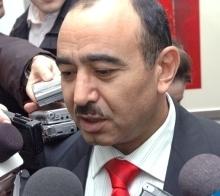
BAKU – A senior presidential administration official has said the planned passage of a libel law in Azerbaijan does not lift responsibility from journalists and they "should be even more responsible" after the law is passed.
Addressing a conference on decriminalization of defamation in Baku on Wednesday, Ali Hasanov said that after the law passes in parliament, a citizen who faces libel or insults from a journalist will still be able to seek legal redress by suing the media outlet employing him.
"If a journalist insults someone, if not himself, the editorial office he works for or the editor may be subject to hefty fines," the presidential aide said. "The editorial office will bear responsibility for every journalist’s writings."
Hasanov said that without the accountability of journalists, disputes will continue to emerge between journalists and government officials and the public "no matter how many laws are passed".
Chairman of Azerbaijani media watchdog Press Council, Aflatun Amashov, recently told journalists that a draft law on defamation has been submitted to parliament and is likely to be passed soon.
Dunja Mijatovic, the OSCE Representative on Freedom of the Media, said officials’ reminding journalists of responsibility was, in itself, unacceptable.
"Why do politicians always talk about journalists’ responsibility?" she queried. "True, they have to be professional, fair and impartial. But if we tell journalists to be responsible, we turn into censors."
Mijatovic admitted that pertinent problems are facing established democracies in Europe as well. However, she said, the public and officials should be tolerant in this respect.
"A journalist should not face criminal charges over his writings. No government should give orders to journalists on how to do their job, and journalists should enjoy suitable conditions to do it," Mijatovic said at the conference, organized by the OSCE Office in Baku and the Press Council.
Mijatovic also welcomed the initiative of the Azerbaijani authorities to decriminalize defamation and join the OSCE countries "that have already taken this important step".
Bilge Cankorel, head of the OSCE Office in Baku, said in his remarks that freedom of expression and freedom of the media are "two of the OSCE’s founding principles". "For this reason, the decriminalization of defamation in Azerbaijan has always been one of the key priorities of the OSCE Office in Baku, and today we are pleased to provide support to the legislative initiative of the Azerbaijan Press Council."
In 2010, the Press Council requested the OSCE office’s assistance in improving media-self regulation mechanisms in the country. In accordance with recommendations provided by the OSCE, the Council revised the Press Code of Ethics to provide clearer guidance on what constitutes ethical conduct in professional journalism.
Wednesday’s conference was attended by more than 80 government officials, lawmakers, civil society and media representatives. Local and international experts outlined international standards on defamation, scope of the domestic legislation and effective measures to protect journalists.
Here we are to serve you with news right now. It does not cost much, but worth your attention.
Choose to support open, independent, quality journalism and subscribe on a monthly basis.
By subscribing to our online newspaper, you can have full digital access to all news, analysis, and much more.
You can also follow AzerNEWS on Twitter @AzerNewsAz or Facebook @AzerNewsNewspaper
Thank you!