
UNESCO event wraps up in Baku
By Nazrin Gadimova
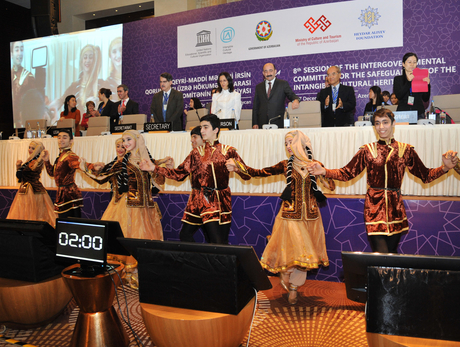
The 8th Session of UNESCO's Intergovernmental Committee for the Safeguarding of the Intangible Cultural Heritage ended up in Baku on Dec 7.
During the session, Ambassador and Permanent Delegate of Peru to UNESCO, José Manuel Rodríguez Cuadros, was elected as the chairman of the next session.
Four elements were also added to the List of Intangible Cultural
Heritage in Need of Urgent Safeguarding in the session. The
elements included Azerbaijan's Chovgan, a traditional Karabakh
horse-riding game, Guatemala's Paach ceremony, Mongolian
calligraphy, Uganda's Empaako tradition of the Batooro, Banyoro,
Batuku, Batagwenda, and Banyabindi.
The Committee also inscribed 25 elements on the Representative List
of the Intangible Cultural Heritage of Humanity, which serves to
raise awareness of intangible heritage and provide recognition to
communities' traditions and know-how that reflect their cultural
diversity.
Among the mentioned 25 elements are Algeria's Annual pilgrimage to the mausoleum of Sidi 'Abd el-Qader Ben Mohammed (Sidi Cheikh); Practices and knowledge linked to the Imzad of the Tuareg communities of Algeria, Mali and Niger; Bangladesh's traditional art of Jamdani weaving; Belgium's Shrimp fishing on horseback in Oostduinkerke; Brazil's Círio de Nazaré (The Taper of Our Lady of Nazareth) in the city of Belém, Pará; China's Zhusuan, knowledge and practices of mathematical calculation through the abacus and Mediterranean diet of Cyprus, Croatia, Greece, Italy, Morocco, Portugal and Spain.
The list also includes Ethiopia's commemoration feast of the finding of the True Holy Cross of Christ; France's Limousin septennial ostensions; Ancient Georgian traditional Qvevri wine-making method; India's Sankirtana, ritual singing, drumming and dancing of Manipur; Italy's celebrations of big shoulder-borne processional structures; Japan's Washoku, traditional dietary cultures, notably for the celebration of New Year; Kyrgyz epic trilogy: Manas, Semetey, Seytek and Traditional craftsmanship of the Mongol Ger and its associated customs.
Moreover, Peru's knowledge, skills and rituals related to the annual renewal of the Q'eswachaka bridge; Republic of Korea's Kimjang, making and sharing kimchi; Romania, Republic of Moldova-Men's group Colindat, Christmas-time ritual; Senegal's Xooy, a divination ceremony among the Serer; Slovakia's Music of Terchová; Former Yugoslav Republic of Macedonia's Feast of the Holy Forty Martyrs in Štip; Turkish coffee culture and tradition; Ukraine's Petrykivka decorative painting as a phenomenon of the Ukrainian ornamental folklore art and Venezuela's La Parranda de San Pedro de Guarenas y Guatire; Vietnam's Art of Đờn ca tài tử music and song are also amongst those 25 elements.
Chaired by Azerbaijani Culture and Tourism Minister Abulfas Garayev, the session brought together more than 780 delegates from 116 countries.
Before the start of the final meeting of the session participants of the event enjoyed Azerbaijani national music, as well as ancient games "Kilimarası", "Maral oyunu", "Qız şahı" and folklore dances.
Addressing the final meeting, Abulfas Garayev expressed his appreciation for the opportunity to hold the 8th session of the UNESCO Intergovernmental Committee for the safeguarding of intangible cultural heritage in Azerbaijan. The minister thanked the former UNESCO Director General Koichiro Matsuura for his part in the session, and current UNESCO Director General Irina Bokova for trust and support.
Garayev also emphasized that Azerbaijani President Ilham Aliyev and First Lady, President of Heydar Aliyev Foundation, Goodwill Ambassador of UNESCO and ISESCO Mehriban Aliyeva, always pat special attention to the issues of cooperation between Azerbaijan and UNESCO.
Former UNESCO Director Koichiro Matsuura for his part said that
the organization of the event was at a high level and praised
success of the session.
Undersecretary of Romania's Ministry of Culture Cajal Marin also
hailed the organization of the event, saying it was really
excellent.
"The session is of great importance. Many issues discussed at the session are really important for participating countries," she underscored.
"I also congratulate Azerbaijani people as Chovqan, a
traditional Karabakh horse-riding game, was incorporated into the
UNESCO Intangible Cultural Heritage List," she added.
During the meeting, UNESCO's Assistant Director-General for
Culture, Francesco Bandarin and Lassana Cissé, Mali's National
Director for Cultural Heritage, signed an agreement whereby Mali
will receive $307,307 in emergency assistance from the Intangible
Heritage Fund for the compilation of an inventory of its intangible
cultural heritage.
The event was concluded by Azerbaijani national dance Yalli, as
well as other dances.
Moreover, International Mugam Centre hosted a grandiose mugham
concert for the participants of the 8th session of the UNESCO
Intergovernmental Commission for Protection of Intangible Cultural
Heritage. People's Artist of Azerbaijan Alim Gasimov and his
daughter, Honoured Artist Fargana Gasimova performed "Shur" mugham.
Their performance was greeted with loud applause.
The 9th session will take place in Paris on November 24-28, 2014.
Composed of 24 states and elected by the General Assembly of the States Parties to the 2003 Convention for the Safeguarding of the Intangible Cultural Heritage, the Intergovernmental Committee meets once every year.
Here we are to serve you with news right now. It does not cost much, but worth your attention.
Choose to support open, independent, quality journalism and subscribe on a monthly basis.
By subscribing to our online newspaper, you can have full digital access to all news, analysis, and much more.
You can also follow AzerNEWS on Twitter @AzerNewsAz or Facebook @AzerNewsNewspaper
Thank you!