
Azerbaijan’s connectivity vision expands as Armenia joins regional digital corridor

Akbar Novruz
Read moreTelecommunications contracts are not usually very interesting to read, aren't they? The language used is functional; the press releases are short; the business case, route diversity, resiliency, and expansion are typical refrains in the telecommunications industry and at infrastructure conferences all around the world. The press release issued Tuesday about the cooperation agreement signed by AzerTelecom, Azerbaijan’s main backbone provider, and Telecom Armenia did not deviate from this pattern.
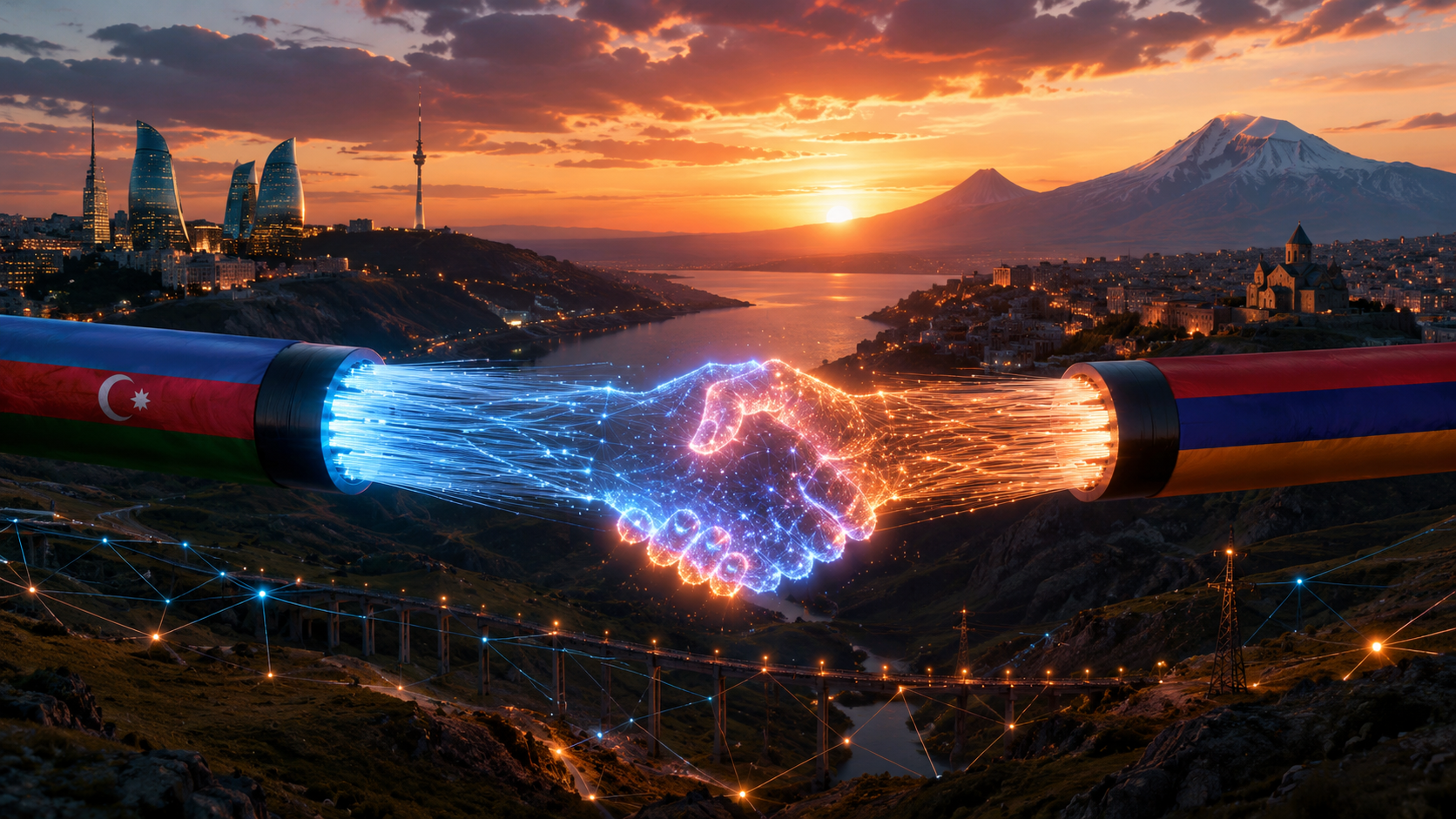
According to the two partners, it was an agreement regarding mutual transit of international Internet traffic with a view to increasing route diversity and resiliency in the South Caucasus region.
The news value of the agreement lies not at all in its bandwidth, but in its geographic implications. For the first time since the dissolution of the Soviet Union, international Internet traffic from Armenia will flow through Azerbaijani territory, which only recently would have been considered unthinkable.
Understanding why a fibre-optic routing deal constitutes geopolitical news is facilitated by considering how Armenia has been accessing the outside world over the last thirty years. Having had its borders closed by Azerbaijan and Türkiye because of the conflict in Karabakh. Armenia has been able to reach out internationally in two ways: north via Georgia and south via Iran. The fact that it was not called a sanctions system is that nobody has imposed this restriction explicitly – it was only a result of an ongoing territorial dispute, where there was no way in which the aggressor and victim would share a cable line. The map of the network infrastructure was the same as that of confrontation.
This default has since changed. AzerTelecom, which is a member of the NEQSOL Holding’s Azerconnect Group and an operator of Azerbaijan’s “Digital Silk Way” project, will transit traffic heading to Armenia on its own network. Telecom Armenia will respond in kind by opening up its network for traffic heading to Azerbaijan. What ensues is a newly created route that connects both networks, a route that never existed until now in a commercial sense.
V principle, finally literal
The policy underpinning the agreement has been in the works for several years prior to this week. After the 2020 war, the President of Azerbaijan, Ilham Aliyev, listed five basic principles that would form the basis of any future peace process: mutual recognition of sovereignty and territorial integrity; renunciation of territorial claims; renunciation of the use of force; demarcation of borders; and, finally, the unblocking of transport and communications. The last of these principles, the unblocking of communications, was by far the most vague one when it was initially formulated. It is now becoming a technical term referring to a real exchange of internet traffic between two networks that previously treated each other as rival infrastructure and thus avoided.
This process has been quite evolutionary, let's say. At the Washington summit of August 2025, a peace agreement between the two governments was initialed. Following the summit, in the coming months, Azerbaijan removed transit limitations for third countries to Armenia and started sending its oil supplies through the rail link through Georgia. Discussions regarding the delimitation of the border have resulted in the delineation of the borders, where an aide of the Azerbaijani president traveled to Armenia this month through this delineated border. Each move is small but significant in its own right. This week’s telecom agreement is no different; in fact, it is possibly the most tangible step so far, because unlike other declarations, the routing of the internet is an either/or proposition.
One of the most fascinating aspects of this agreement is who actually made it. Unlike the declarations from Washington or the Dilijan sessions between presidential representatives and security council secretaries, here we see a transaction between two businesses, which consider themselves telecom operators, who claim to work to extend the geographical coverage of the network they operate because they want to be a digital link connecting Europe and Asia. From the point of view of AzerTelecom, their intention is quite clear, and from the point of view of Telecom Armenia, the rationale behind this is also easy to understand.
AzerTelecom is at the same time laying, with the help of the Kazakhs, a fibre-optic cable across the bottom of the Caspian Sea, becoming thus a part of the larger east-west digital highway [ Trans-Caspian fibre-optic cable]. The newly established transit line for Armenia through Azerbaijan is not just connecting two neighboring networks, but connects Armenia for the first time to the newly established European-Asian data highway constructed by Baku over several years.
And well, you know what they say in the grand scheme of the theory of international relations, statements made by diplomats are statements of intent that can be changed by the government later on. Business deals are usually done since there is economic logic in place. After the deal is made, there is property created, income generated, and dependencies created that are difficult to break. In this sense, the agreement signed today, represents a small but real increase in what political scientists describe as interdependence.
------
The bigger cable and the 'big if'
This Internet Transit Agreement is of modest dimensions. A much more significant test of Armenia’s absorption within the region’s connectivity framework or staying on the peripheries thereof is seen at sea, in the Black Sea Green Energy Corridor, which is the biggest project of its kind the South Caucasus region has launched so far this decade. This Corridor, defined in the strategic partnership agreement signed in Bucharest in December 2022 by Azerbaijan, Georgia, Romania and Hungary, involves building a 1,100 km long high voltage submarine cable that would transport renewable energy generated in the Caspian Sea via Georgia’s Black Sea coast to Romania, providing the power straight to Europe’s internal electricity network. In January 2023, Bulgaria expressed its interest in participating in the project. The Corridor has already overcome some institutional barriers: it has received the status of Project of Mutual Interest from the European Union, included in ENTSO-E Ten-Year Network Development Plan evaluation for 2026, and is supported by a projected €2.3bn of European funding out of the total estimated cost of around €3.5-3.8 billion. The feasibility study for the project will be completed in the summer of 2026.
And look at what is not on this list. The route of the cable goes from Azerbaijan through Georgia, across the Black Sea, into Romania – a route that, consciously or unconsciously, reproduces the exact same geographic logic that excluded Armenia from the internet pathways for three decades. Armenia is not a party to the project, nor a shareholder of the Green Energy Corridor Power Company that will construct the route, and is not presently involved in any of the plans for the point at which the cable comes ashore. Perhaps, its inclusion here sounds irrelevant, at least now.
That will be determined by the political factor that looms large over all else in this process of normalisation: namely, whether the treaty endorsed by Washington is actually signed, and whether the Armenian constitutional issue is sorted out in a way Baku can accept. If so, the case for including Armenia in the project will be difficult to ignore on purely business terms. Armenia is situated strategically between Azerbaijan and the other planned terminal points for the project in Georgia; a fibre-optic submarine cable, to be laid along with the power line, is planned in any event. An Azerbaijan-Georgia-Türkiye-Bulgaria "green energy corridor" project, announced in a separate memorandum in April 2025, shows that Baku is ready to develop several parallel transmission lines across the territory of the partner countries, rather than limit itself to using a single point of entry. There is nothing technically preventing such a project from eventually incorporating treaty-bound Armenia somewhere down the road.
The case for, and against. In favour: Armenia would gain a second clean-energy export route and a stronger claim to EU infrastructure funding, of the kind already flowing to Georgia; Azerbaijan would gain another customer-stakeholder bound into its connectivity architecture, deepening exactly the interdependence this normalisation process is meant to produce. Against: the existing four-party shareholder structure and EU funding commitments are already advanced, the feasibility study is concluding without Armenia in scope, and inserting a new state into a near-finalised consortium would require renegotiating cost-sharing, routing and governance arrangements that have taken over three years to settle. Realistically, any Armenian role is more likely to arrive via a second-generation interconnector or fibre link than a late amendment to the existing Black Sea project.
It is worth noting that even a supporting role would have a significant impact. The recently concluded internet transit deal demonstrates exactly how Armenian participation in regional infrastructural projects is possible in its most practical form: bilateral and commercial. An electricity connection or fiber optic cable in relation to the Black Sea route would amount to the exact same process being undertaken on a grander scale, and would do more than any press release to address the issue of whether Armenia is becoming an active participant in the region’s infrastructural future or will continue to represent the blank space on the map that everyone routes around.
Here we are to serve you with news right now. It does not cost much, but worth your attention.
Choose to support open, independent, quality journalism and subscribe on a monthly basis.
By subscribing to our online newspaper, you can have full digital access to all news, analysis, and much more.
You can also follow AzerNEWS on Twitter @AzerNewsAz or Facebook @AzerNewsNewspaper
Thank you!