
NASA discovered two extremely low-density exoplanets
by Alimat Aliyeva
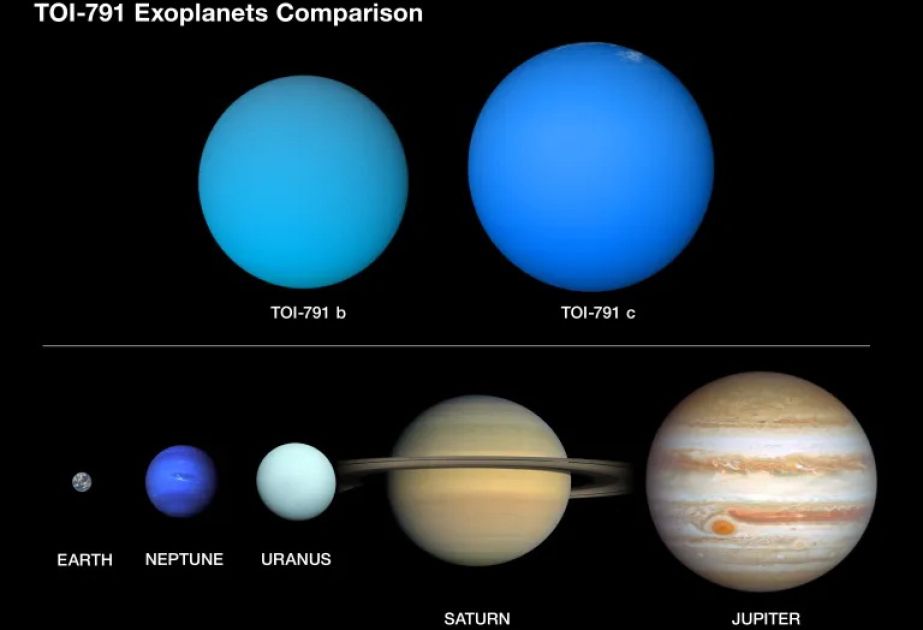
Astronomers have discovered an unusual system of two giant exoplanets with record-low densities orbiting a single star. According to NASA, this finding could help scientists better understand how planetary systems form and evolve over time, AzerNEWS reports.
The planets, designated TOI-791 b and TOI-791 c, are located approximately 1,110 light-years from Earth in the constellation Volans. Although both worlds are similar in size to Jupiter, their masses are surprisingly small.
Researchers estimate that the average density of TOI-791 b is about 0.038 grams per cubic centimeter, while TOI-791 c has a density of roughly 0.047 grams per cubic centimeter. For comparison, these values are close to the density of cotton candy and more than ten times lower than that of Jupiter, making them some of the “lightest” giant planets ever observed.
The discovery was made using data from NASA’s TESS (Transiting Exoplanet Survey Satellite), which detects exoplanets by measuring tiny dips in a star’s brightness as planets pass in front of it.
What makes this system especially interesting is the gravitational interaction between the two planets. Their orbits are closely linked, allowing scientists to refine measurements of their masses and confirm their unusually low densities with higher accuracy than usual for such distant worlds.
One leading hypothesis suggests that these planets possess extremely inflated atmospheres dominated by hydrogen and helium. Intense heat from their host star may be causing their outer layers to “puff up,” making them appear much larger and less dense than expected. In extreme cases, such planets are sometimes referred to as “super-puff” worlds.
Interestingly, this system could provide a rare natural laboratory for studying atmospheric escape — a process where a planet’s atmosphere gradually evaporates into space. Over time, this may even transform such giants into much smaller, rocky remnants.
Future observations with the James Webb Space Telescope (JWST) are expected to analyze the chemical composition of their atmospheres in greater detail, potentially detecting elements like water vapor, methane, or exotic hazes that could explain their unusual structure.
Overall, the discovery of TOI-791 b and TOI-791 c adds another piece to the puzzle of planetary diversity, showing that nature can produce worlds far stranger — and far “lighter” — than anything found in our own Solar System.
Here we are to serve you with news right now. It does not cost much, but worth your attention.
Choose to support open, independent, quality journalism and subscribe on a monthly basis.
By subscribing to our online newspaper, you can have full digital access to all news, analysis, and much more.
You can also follow AzerNEWS on Twitter @AzerNewsAz or Facebook @AzerNewsNewspaper
Thank you!