
The lost palace
By Nigar Orujova, Azernews Staff Writer
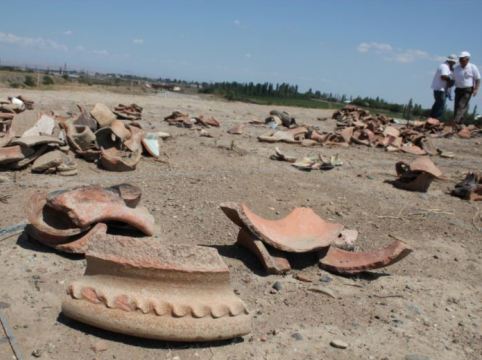
The biggest palace of Shirvanshahs aged nearly 1,000 years has been discovered during excavation work in Shamakhi city, central Azerbaijan, the local media reported last week.
The ruins of the historical palace were found during the construction work around a school, says head of Shamakhi archaeological expedition of the Azerbaijan National Academy of Sciences Archaeology and Ethnography Institute, Shirzad Ahmedov.
The ruins are considered to be the remains of an ancient Shirvanshahs dynasty palace dating back to 11-12th centuries. The excavations in an area of 900 square meters revealed household items, coins and waterlines. The palace with the height of four meters has thick walls ranging 2.5 meters.
"Earthquakes, enemy attacks and local people destroyed approximately 7-8 meters of the palace," Ahmedov said. "The remaining part of the palace spanning 100 square meters is still under the building of school No. 1."
According to Ahmedov, the palace was presumably ruined during the Soviet times -- in 1939-1946 -- to build a school.
A scrutiny revealed that the palace's stones were used while building the school, while seven out of 13 water pipes were used as smoke stacks.
A powerful earthquake recorded in 1192 destroyed the palace and killed the Shah Akhsitan I family. Ahmedov noted the possibility of carrying out restoration and preservation work in the palace.
Different historical monuments related to Shirvanshahs, including mosques, bridges, hamams (bathhouses) and caravanserais (hotels), are available in Shamakhi.
The Shirvanshahs history
The state of Shirvanshahs, founded in the first half of the VI century between Shabran and Gilgilchay, existed for about 1000 years. As before, the information about the Shirvanshahs, who depended on Arab Caliphate, is very scarce. In 861 Arab origin Mazyadis had gained the independence of the Shirvanshahs. The Shirvanshahs' state had borders with Derbent and Samur River in the north, Kura River in the south, and Goychay, Sheki in the west, and the Caspian Sea in the east. This state at certain times had been ruled by various dynasties: Mazyadis (861-1027), Kasranids (1027-1382) and Darbandis (1382-1538). In 1538 it was united to Safavid state.
Its capital was previously Shirvan, and since the 1st quarter of X century -Yazidiyya (Shamakhy).
The Shirvanshahs dynasty, existing as an independent or a vassal state, from 861 until 1538, (longer than any other dynasty in the Islamic world) are known for their support of culture. The two periods of an independent and strong Shirvan state are the 12th century, under Sultans Manuchehr and Akhsitan who built the stronghold of Baku, and the 15th century under Derbendid dynasty. In the 13th and 14th centuries Shirvan was a vassal of stronger Mongol and Timurid empires.
Shirvanshahs built many defensive castles across all of Shirvan to resist foreign invasions. From the walled city of Baku with its Maiden Tower (XII) and many medieval castles in Absheron to impregnable strongholds all over the mountains of Shirvan and Shaki, there are many great examples of medieval military architecture.
Baku's Shirvanshahs Palace is known as the biggest monument of the Shirvan-Absheron branch of Azerbaijani architecture, situated in the Old City of the Azerbaijani capital. The complex includes the main building of the palace, Divanhane, burial-vaults, the Shah's mosque with a minaret, Seyid Yahya Bakuvi's mausoleum, Murad's Gate, remnants of a bath-house, etc.
The Shirvanshahs Palace has been inscribed in UNESCO World Heritage List since 2000.
Here we are to serve you with news right now. It does not cost much, but worth your attention.
Choose to support open, independent, quality journalism and subscribe on a monthly basis.
By subscribing to our online newspaper, you can have full digital access to all news, analysis, and much more.
You can also follow AzerNEWS on Twitter @AzerNewsAz or Facebook @AzerNewsNewspaper
Thank you!