
From Moscow to Sochi
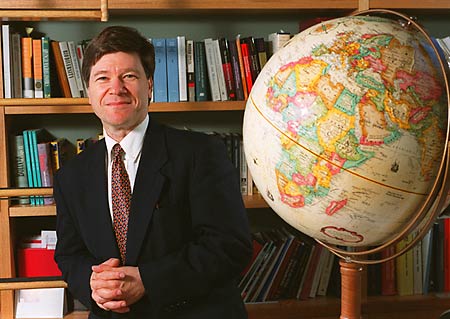
Professor of Sustainable Development, Professor of Health Policy and Management, and Director of the Earth Institute at Columbia University. He is also Special Adviser to the United Nations Secretary-General on the Millennium Development Goals.
The Winter Olympics in Sochi are the first to be hosted by
Russia since the Cold War-era Moscow Summer Games in 1980.
Obviously, much has changed politically in the interim. But today's
Games also create an opportune moment to look back at Russia's
recent economic history - and to peer forward as well.
Many people who remember the collapse of the Soviet Union in 1991
and its tumultuous aftermath believe that Russia's economy today
must be impoverished and unstable - and far behind booming China.
Wrong. According to the International Monetary Fund, Russia's per
capita income in 2013, measured in terms of purchasing power
parity, is roughly $18,600, nearly double China's per capita income
of around $10,000. And, according to World Bank data, extreme
poverty is close to zero, compared to 11.8% in China in 2009 (the
most recent year for which data are available).
Yes, Russia's economy has been buoyed recently not only by sound
macroeconomic policies, but also by high world oil and gas prices.
In fact, the collapse of world oil prices after 1985 contributed to
the severe economic crisis in the Soviet Union and Russia in the
late 1980's and early 1990's. This is an important point, given
that the economic reforms implemented by former Soviet President
Mikhail Gorbachev and former Russian President Boris Yeltsin thus
confronted powerful headwinds.
For two years (1992-1993), I was a macroeconomic adviser to Prime
Minister Yegor Gaidar and Finance Minister Boris Fyodorov, trying
to help Russia to end the high inflation and extreme shortages that
characterized the last years of the Soviet era, and to begin
Russia's transition to a market economy. I recommended a
macroeconomic stabilization strategy that had been highly
successful in nearby Poland, and that called for timely financial
assistance from the United States, Europe, and the IMF, just as
Poland had received.
Unfortunately, the West did not provide the needed financial
assistance, contrary to my (and many other people's)
recommendations, and the Russian economic and financial calamity
was more severe as a result. At the time, I attributed Western
inaction to incompetence on the part of the US government and the
IMF. Looking back, it is clear that there was also a deliberate
strategy by US neoconservatives, such as then-Defense Secretary
Dick Cheney, to weaken the new Russian state. The US government was
also complicit during the mid-1990's in the plundering of Russian
state-owned property, including oil assets that were unscrupulously
privatized.
The good news is that Russia was able to bounce back from those
terrible years, no thanks to the West or the US government.
Russia's market economy, albeit marred by corruption, took root.
After several years of political infighting and unnecessary delay,
macroeconomic stabilization was achieved, and Russia's economic
growth was restored, especially as world oil and gas prices began
to rise. From 2001 to 2013, Russia's GDP grew at a robust 4.4%
average annual rate.
Russia achieved a good measure of financial stability as well. The
IMF puts Russia's inflation rate at 6.9% in 2013, with unemployment
at 5.5%, while the budget deficit was just 0.3% of GDP. Moreover,
Russia's foreign-exchange reserves stand at a healthy $500
billion.
But Russia could achieve still greater success by basing its
economy on two growth engines rather than one. Oil and gas will
continue to provide a strong lift to Russia for years to come,
especially as China becomes a major customer. Yet Russia also has
vast and still under-developed potential in many global high-tech
industries.
During the Soviet era, Russia produced a vast array of
technology-based industrial products, from airplanes to computers
to sophisticated machine goods. Unlike Chinese industry, Russia's
manufacturing branches were almost completely cut off from world
markets, both by the Cold War and by Soviet planning. When
post-Soviet Russia opened itself to trade, its industrial
enterprises lagged far behind cutting-edge technologies, especially
in the dynamic information and communications technology (ICT)
sector.
Many industries collapsed, owing to neglect, lack of international
partners, and financial chaos. Those that survived did so only
barely, with greatly reduced output going mainly to the ex-Soviet
market.
Russia has the know-how, skilled engineering, and natural-resource
base to become a global competitor in a range of major high-tech
industries, including nuclear energy, commercial aviation,
commercial space technology (including satellites and GPS), ICT
hardware and software, electric vehicles, high-speed rail,
petrochemicals, and heavy equipment for the mining and hydrocarbon
sectors. All of these industries will benefit from the potential
for enormous demand growth in large markets, such as China, Africa,
and India.
But achieving long-term growth led by high-tech industries requires
a business environment that encourages private-sector investment,
including openness to foreign players. Moreover, the social and
political environment must be conducive to a high-tech labor force,
providing an attractive quality of life, ensuring civil liberties,
and supporting entrepreneurship and creativity. Finally, economic
policies must promote technological advances and global technical
cooperation in promising sectors.
It is notable that Russia recently completed an agreement to
finance a nuclear power plant in Hungary, and looks likely to do
the same in Turkey. The demand for nuclear energy will grow as part
of the global effort to decarbonize the world energy system.
Russia's new reactors seem to be safe and competitive with those
produced elsewhere. Similarly, we might see new Russian-built
civilian aircraft entering the global market in partnership with
international firms, especially those that can work with Russian
companies on advanced ICT avionics.
Back in 1991, many thought that Russia could not end high
inflation, adopt a market economy, or compete effectively in world
markets. Two decades later, Russia has proved the skeptics wrong.
Yes, Russia remains too dependent on oil and gas, and should move
further on transparency, openness, and competition in business and
governance. Yet the trend is positive: Russia has become a stable,
high-income market economy, with strong prospects for decades of
rapid GDP growth and high-tech progress if it pursues a sensible
economic strategy in the coming years.
Copyright: Project Syndicate
Here we are to serve you with news right now. It does not cost much, but worth your attention.
Choose to support open, independent, quality journalism and subscribe on a monthly basis.
By subscribing to our online newspaper, you can have full digital access to all news, analysis, and much more.
You can also follow AzerNEWS on Twitter @AzerNewsAz or Facebook @AzerNewsNewspaper
Thank you!