
Iran, Iraq seek to expand relations
By Sara Rajabova
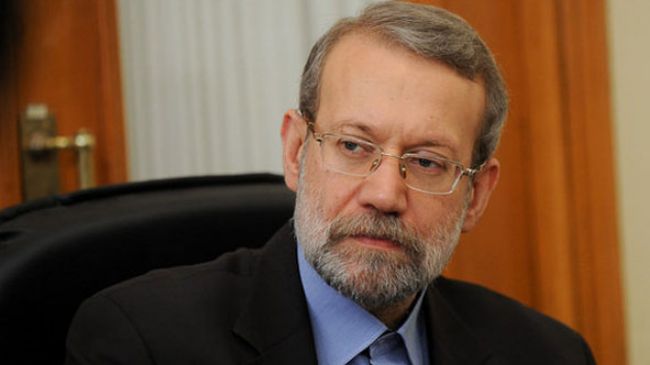
Iranian Parliament Speaker Ali Larijani has said the expansion of relations between Iran and Iraq is in the interest of the two countries.
Larijani made the remark at a meeting with Iraqi Minister of Justice Hassan Al-Shimari in Tehran on Monday, IRNA news agency reported.
"Iran has always supported the people of Iraq in the aftermath of the fall of the country's former dictator... expansion of ties in various fields is in the interest of the two Muslim countries," Larijani said.
The fall of Saddam Hussein in 2003 sparked a new era in Iran-Iraq relations. Ties between the two states had been severely damaged by the Iran-Iraq War in 1980-1988, but since 2003, Iran has reportedly worked vigorously to extend its economic and political reach using both diplomatic and military means.
The Iranian parliament speaker called for unity among political groups in Iraq, saying: "Some states are trying to undermine the political sovereignty of Iraq by sowing discord among political groups."
He added that dialogue between the two countries would lead to peace and stability in the region.
In turn Al-Shimari hailed the expansion of relations between the two neighboring countries.
Regarding the members of the anti-Iranian Mujahedin-e Khalq Organization (MKO), the Iraqi minister of justice said the country was working to expel them from Iraq.
MKO terrorists, blamed for the assassination of many Iranian people and officials after the 1979 Islamic Revolution, fled to Iraq in the 1980s where they enjoyed the support of Saddam Hussein, who allowed them to set up a military base in the eastern province of Diyala, near the Iranian border.
According to the reports, MKO members currently live at Camp Liberty, a former US military camp near Baghdad Airport, after their relocation from their former Camp Ashraf under growing pressure from the Iraqi government and people for the terrorist group to leave the country.
Earlier in April, Iran's Intelligence Minister Heidar Moslehi visited the Iraqi capital, Baghdad, for talks with the country's senior officials on ways of improving bilateral relations.
The Iranian minister said his visit to Iraq was aimed at exploring avenues for enhancing Tehran-Baghdad relations, particularly in the fields of security.
Iraq and Iran have developed extensive economic ties since 2003. In 2010, Iranian officials reported that trade between the two countries had increased ten-fold since 2003 and was expected to surpass $8 billion by the end of the year.
Iran has also headed numerous reconstruction projects in Iraq. As of January 2010, the two countries had signed over 100 economic and cooperation agreements.
Economic cooperation between Iran and Iraq continues to increase, and in 2011, Iraq, Iran and Syria signed a $10 billion natural gas deal in which the three countries agreed to construct a pipeline originating in southern Iran and extending to Syria; Iranian officials indicated that the pipeline would eventually extend to the Mediterranean through Lebanon.
In March 2008, Mahmoud Ahmadinejad became the first Iranian president to visit Iraq since Iran's 1979 Islamic revolution. Iraqi Prime Minister Nouri al-Maliki has made several state visits to Iran since 2006 and expressed sympathy with Iran over its nuclear energy program. Iran today is Iraq's largest trading partner.
Here we are to serve you with news right now. It does not cost much, but worth your attention.
Choose to support open, independent, quality journalism and subscribe on a monthly basis.
By subscribing to our online newspaper, you can have full digital access to all news, analysis, and much more.
You can also follow AzerNEWS on Twitter @AzerNewsAz or Facebook @AzerNewsNewspaper
Thank you!