
20 years since Kalbajar occupation
By Sara Rajabova
Twenty years have passed since the occupation of Azerbaijan's Kalbajar region by Armenian armed forces.
Launching a large-scale military operation on March 27, 1993, the Armenian armed forces occupied the Kalbajar region on April 2.
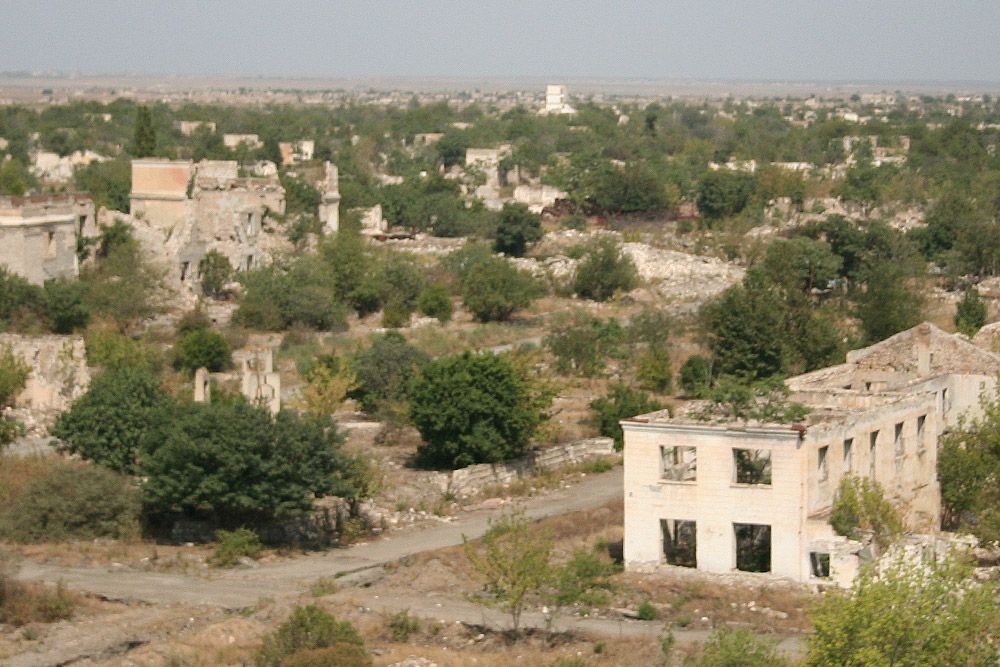
Kalbajar, a region of 1,936 square kilometers located outside Nagorno-Karabakh, was the scene of torture of innocent people by the Armenian invaders.
As a result, 511 people died, and 321 went missing or were captured. 55 soldiers were killed during the fighting. 53,340 residents of the Kalbajar region became IDPs. Moreover, 132 settlements and Kalbajar's gold deposits were seized by the Armenians. The invader destroyed more than 500 industrial, construction, catering and retail facilities, 97 schools and 76 health facilities.
The Armenians also destroyed an Albanian temple in Vang village, an Albanian church in Cherekdar, Lok fortress in Ganlikend, Ulukhan fortress in Garajanli, an Albanian church on Tartar River, the fortresses of Galabonu, Jomerd, Keshikchi, mosques in the town of Kalbajar and Otaqli village, Taglidash Bridge over the Tartar River, a museum of history and ethnography, Ashig Shamshir Cultural House, and Seyid Asadullah shrine in Soyudly summer field of Kalbajar region.
After the occupation of Kalbajar the Armenians continue to plunder the natural resources, historical and religious monuments in the region.
Currently the Armenians residing in the occupied territories have destroyed most of the substantial natural monuments.
The ayifindigi trees in the occupied Kalbajar region spanning a 968 hectare area and included in the Red Book are subjected to mass destruction and are being sold abroad.
Kalbajar's economy has sustained damage worth 703.528 million rubles as a result of the occupation of the region.
Kalbajar was rich in natural resourses, especially gold fields, such as Soyudlu-Zod with 112.5 tons of industrial resources, which is also in exploitation, and Aghduzdagh and Tuxtun with more than 13 tons of resources.
Soyudlu-Zod in Kalbajar has been a well-known gold field for centuries. The tapping of the field started in the 3rd millennium B.C.E. Geological exploration carried out at Soyudlu in the 1970-80s revealed ancient pits, caves, wells, rock and ore fragments, as well as tools used in the extraction of gold. This is evidence that people produced gold there 4-5 millennia ago. The Zar village went down in history as "Shahrizar", i.e. a golden town.
Kalbajar was also famous for its water springs Upper Istisu, Lower Istisu, Keshdek, Garasu, Tutxun, Mozchay, and Goturlusu, which are under the Armenian occupation.
Information about Istisu mineral water springs was first provided in 12th century sources, but geological researches have revealed that terminal springs and mineral waters of Istisu existed even earlier. First chemical analysis of Kalbajar's Istisu was conducted in 1927, while a resort construction commenced in the late 1920s. Medical resorts, hospitals and hotels were built in Upper Istisu in 1951.
The Kalbajar mineral water comes out to the surface at a temperature of 62 to 75 degrees. In some wells it is even higher. Since the ancient times, people have been coming to Istisu to cure their health problems. The baths set up around mineral water fountains are used by visitors from all over the world. Along with mineral water, there is a lot of carbon gas there, which is used in bottling the water.
According to the Azerbaijani Ecology and Natural Resources Ministry, the Armenians produce the Istisu mineral water with the name "Jamruk" and export it to Iran.
Unfortunately, these rich natural resources, which are property of the Azerbaijani people, are being plundered by Armenian vandals.
Kalbajar's residents, who live with a sense of homesickness, will never forget about the terrible days of the Armenian invasion.
Following the region's occupation, the U.N. Security Council adopted Resolution 822 demanding an immediate withdrawal from the region and other occupied areas of Azerbaijan. Armenia has not fulfilled the resolution.
In addition, contrary to the UN and OSCE principles, the Armenians have pursued purposeful settlement of people in Kalbajar since 1999.
Azerbaijan and Armenia for over two decades have been locked in conflict, which emerged over Armenian territorial claims. Since a lengthy war in the early 1990s, Armenian armed forces have occupied over 20 percent of Azerbaijan's internationally recognized territory, including Nagorno-Karabakh and seven adjacent regions. The UN Security Council has adopted four resolutions on Armenia's withdrawal from the Azerbaijani territory, but they have not been enforced to this day.
A precarious cease-fire was signed in 1994. However, units of the Armenian armed forces commit armistice breaches on the frontline almost every day.
Despite the vandalism committed by Armenian invaders against the Azerbaijani people, these heinous acts have not received due condemnation by the world community to date.
The Azerbaijani people are still having to tolerate the Armenian vandalism and the unjust position and double standards of the international community.
Here we are to serve you with news right now. It does not cost much, but worth your attention.
Choose to support open, independent, quality journalism and subscribe on a monthly basis.
By subscribing to our online newspaper, you can have full digital access to all news, analysis, and much more.
You can also follow AzerNEWS on Twitter @AzerNewsAz or Facebook @AzerNewsNewspaper
Thank you!